
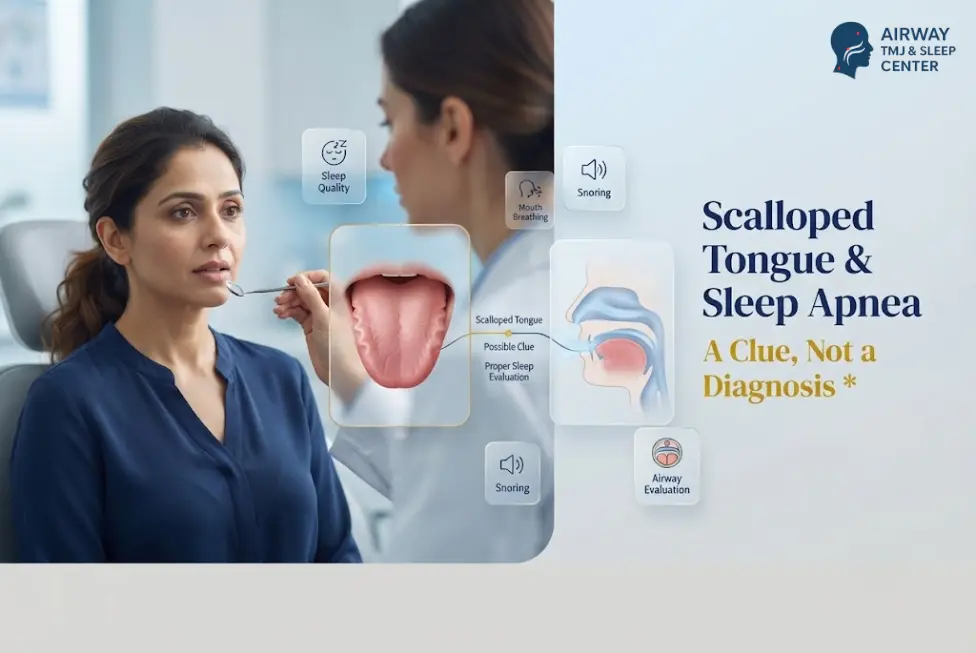
A scalloped tongue has wavy indentations along its sides where it rests against the teeth. It is sometimes described among tongue signs of sleep apnea, and research suggests it may strengthen suspicion in some high-risk patients. It cannot confirm OSA, grade its severity or rule it out. Diagnosis requires a comprehensive sleep evaluation and objective testing.
A scalloped tongue has wavy indentations along its sides where it rests against the teeth. It is sometimes described among tongue signs of sleep apnea, and research suggests it may strengthen suspicion in some high-risk patients. It cannot confirm OSA, grade its severity or rule it out. Diagnosis requires a comprehensive sleep evaluation and objective testing.
Do not diagnose from a tongue photo
A photo cannot measure breathing events, oxygen changes or sleep disruption. Do not buy a mouthpiece, start CPAP, tape your mouth or dismiss symptoms based only on tongue shape. Use the finding to start a proper sleep and oral evaluation.
What does a scalloped tongue mean?
Scalloping means the tongue’s side borders look wavy where they contact the teeth. It shows tongue-to-tooth contact, not why it occurs. Relative tongue and dental-arch size, swelling, posture or habits may contribute. The 2025 study noted subjective assessment and did not evaluate macroglossia or other craniofacial factors, so the same appearance can arise through different pathways.
Scalloped tongue and sleep apnea: clue versus diagnosis
| What you notice | What it may suggest | What it cannot prove | Reasonable next step |
| Scalloped edges alone | The tongue has been contacting the teeth; oral space, tongue size, swelling or habits may contribute | Sleep apnea, its cause or its severity | Notice whether it is new or persistent; seek dental or medical review if concerned |
| Scalloping plus loud snoring, gasping or witnessed pauses | A stronger reason to discuss obstructive sleep apnea risk | Whether OSA is present, or whether it is mild, moderate or severe | Arrange a comprehensive sleep evaluation and clinician-selected sleep test |
| Scalloping plus daytime sleepiness, morning headache or unrefreshing sleep | Symptoms add clinically useful context | That OSA is the only possible cause of tiredness or headache | Discuss the complete symptom pattern rather than asking for a diagnosis from a photo |
| Severe sleepiness or a near-miss while driving | An immediate safety problem that may accompany a sleep disorder | The cause of the sleepiness | Do not drive when sleepy; get to a safe place and seek prompt medical assessment |
What did the research actually find?
The 2005 diagnostic study
In 61 ear, nose and throat clinic patients, scalloping had 52% sensitivity and 68% specificity for known or newly documented OSA. It therefore missed many people with OSA and appeared in some without it. Only 25 participants underwent polysomnography, making this a small, selected sample.
The 2025 sleep-laboratory study
A newer report analysed 160 patients from one Brazilian sleep laboratory. Ninety percent had OSA and 41% had severe OSA. Scalloping was not significantly associated with OSA overall, but it was associated with severe OSA and greater intermittent oxygen drops in the models.
This makes scalloping one possible clue in someone already being assessed, not a public self-test. The authors noted referral and selection bias, subjective scoring, a one-centre design, excluded photographs and unmeasured oral factors.
Why can tongue shape not diagnose sleep apnea?
Obstructive sleep apnea is defined by repeated airway obstruction during sleep. A tongue photograph cannot record airflow, breathing effort, blood-oxygen changes, heart rate, arousals or sleep stages. It also cannot distinguish OSA from primary snoring or explain whether tiredness comes from another sleep or medical problem.
AASM guidance goes further: even clinical tools, questionnaires and prediction algorithms should not diagnose adult OSA without polysomnography or a technically appropriate home sleep apnea test. A single visual sign therefore belongs in risk assessment, not in the diagnosis box.
Symptoms that matter more than the tongue photo
| During sleep – often reported by another person | Morning or daytime |
| Frequent loud snoring; breathing that stops and starts; gasping, choking or snorting; restless sleep | Unrefreshing sleep; excessive sleepiness; dry mouth; morning headache; fatigue; difficulty focusing; frequent night-time urination |
Concern rises when several features occur together, especially witnessed pauses, gasping and meaningful sleepiness. Tell the clinician about medical conditions, medicines, alcohol use, nasal blockage and previous testing. OSA occurs across body sizes, so weight or tongue shape cannot rule it out.
When should you request a sleep evaluation?
- Start with the pattern. Write down snoring, gasping, witnessed pauses, awakenings, morning symptoms and daytime sleepiness. A bed partner’s observations can help.
- Arrange a comprehensive evaluation. A dental sleep clinician may identify oral findings and screen risk; a medical sleep clinician evaluates the full sleep and health history.
- Use the correct objective test. A home test may suit selected uncomplicated adults at increased risk. Polysomnography is the standard and suits complex situations.
- Follow up an unclear result. AASM guidance recommends polysomnography when a single home test is negative, inconclusive or technically inadequate and concern remains.
- Choose treatment after diagnosis. CPAP, a custom oral appliance and other options are selected from the confirmed condition, severity, anatomy, health and patient preferences – not from a tongue image.
When should you act quickly?
Prompt or urgent action
Seek prompt sleep assessment for witnessed pauses, repeated gasping or choking, or severe daytime sleepiness.
Do not drive when sleepy. If you become drowsy while driving, pull off the road safely. A near-miss is a safety warning, not something to monitor casually.
Get emergency help for sudden major tongue or throat swelling, breathing or swallowing difficulty, or another acute medical emergency. These are not routine signs to manage as sleep apnea at home.
Sleep and airway assessment in Noida
Airway TMJ & Sleep Center can examine tongue-to-teeth contact and other oral findings, review the symptom pattern and coordinate an appropriate sleep-testing pathway. An oral examination can support risk assessment; it does not replace a medically interpreted sleep study.
Read the sleep apnea symptoms and causes guide, compare home and laboratory sleep testing, or contact the clinic to request a symptom-led assessment rather than a tongue-photo diagnosis.
| Request a sleep and airway assessment
Call +91 87566 15325. Airway TMJ & Sleep Center, C-98/10, C Block Market, Sector 41, Noida 201301. Bring previous sleep reports and a list of night-time and daytime symptoms. |
The bottom line
A scalloped tongue can be a useful conversation starter, particularly when loud snoring, witnessed pauses, gasping or daytime sleepiness are also present. It cannot diagnose or exclude sleep apnea. Look beyond the photo, assess the whole pattern and use clinician-selected objective testing to get an answer.