
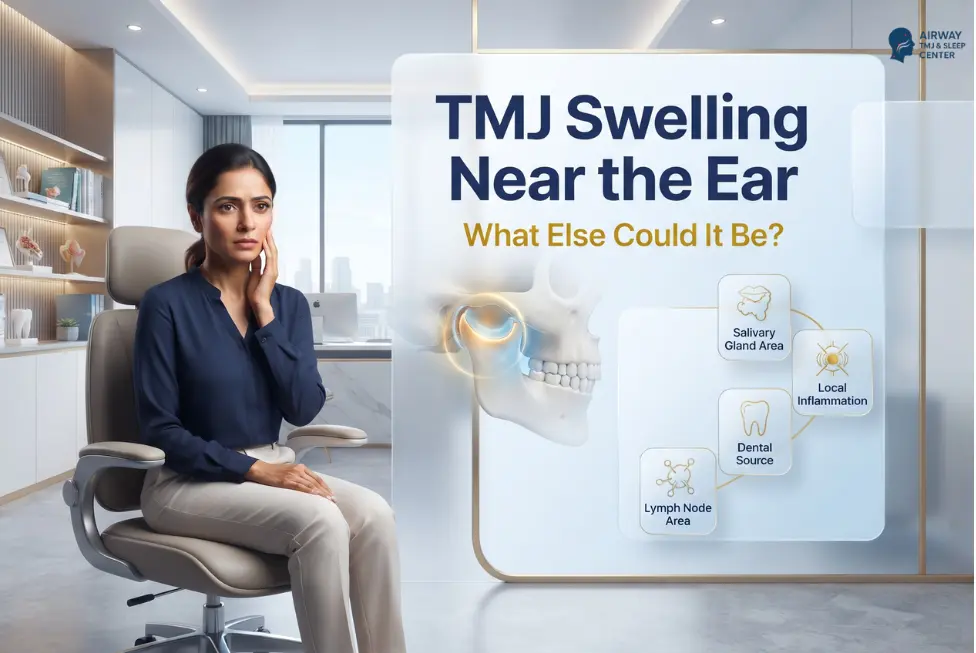
TMJ swelling is not a diagnosis. A swollen jaw on one side or a lump near the ear may come from the jaw joint, a tooth or gum infection, a salivary gland, lymph nodes, the ear, skin or an injury. Location and accompanying symptoms provide clues, but visible or worsening swelling needs an in-person examination.
The jaw joint sits beside teeth, the parotid gland, the ear and several lymph nodes. A patient can point to the same small area for very different problems. Treating every swelling as routine TMD risks delaying dental drainage, antibiotics, ear treatment or emergency airway care.
Emergency warning
Go to the nearest emergency department now for difficulty breathing, speaking or swallowing; rapidly spreading mouth, face or neck swelling; major swelling affecting the eye or vision; severe bleeding; or collapse/confusion. Do not wait for a routine TMJ appointment.
Why swelling near the jaw or ear is different from routine TMD
NIDCR describes common TMD patterns as pain in the chewing muscles or jaw joint, stiffness, limited movement or locking, painful joint sounds and bite change. These symptoms can overlap with other conditions, and the diagnosis requires a history and examination.
Swelling can occur around an inflamed or injured joint, but obvious facial swelling is not enough to label the problem ‘TMJ inflammation.’ A rare infection inside the TMJ can cause preauricular swelling, severe pain and restricted opening; dental, salivary, ear and skin infections are also important alternatives. This is why acute swelling changes the urgency.
Jaw swelling near the ear: compare the location and clues
| Where is it? | Clues that may travel with it | Possibilities to examine | First contact |
| Directly in front of the ear | Pain with chewing or movement, tenderness, clicking, stiffness or locking | A TMD is possible. Marked redness, fever, rapidly reduced opening or obvious swelling also raises concern for infection or another acute condition. | Dentist, TMJ/orofacial pain clinician; urgent medical review if acute red flags |
| Cheek, gum or beside one tooth | Tooth or gum pain, pain on biting, heat/cold sensitivity, bad taste, fever or difficulty opening | Dental abscess, gum infection, an impacted tooth or another dental cause. An abscess needs urgent dental treatment and will not resolve by itself. | Urgent dentist or oral/maxillofacial service |
| In front of the ear or upper cheek | Dry mouth, foul taste, redness, fever, or squeezing pain and swelling—sometimes worse while eating | Parotid salivary-gland blockage or infection. Viral causes can affect one or both sides, but examination is needed. | Doctor or ENT; same-day care if infection signs |
| Under the jaw or floor of the mouth | Pain or swelling that flares with meals, dry mouth, a hard point under the tongue, redness or pus | Submandibular salivary-gland stone or infection; dental infection and lymph nodes can occur nearby. | Dentist, doctor or ENT; emergency care if swallowing or breathing is affected |
| Behind the ear | Redness or tenderness, fever, ear discharge, hearing change, or the ear appearing pushed outward | Mastoiditis is rare but serious and needs rapid assessment, especially after or during an ear infection. | Urgent medical or hospital assessment |
| Under the chin or along the neck | One or more tender lumps with sore throat, cough, fever, dental or ear symptoms | Reactive lymph nodes are common. A hard, fixed, enlarging or unexplained persistent lump needs medical review. | Doctor; urgent help if breathing or swallowing is difficult |
| Red, hot skin over the jaw or face | Tenderness, rapidly spreading redness, fever, a wound, boil, rash or drainage | Skin infection such as cellulitis or an abscess; the source may still be dental and should be examined. | Same-day medical or dental assessment |
| After a fall, blow or procedure | Bruising, bleeding, numb lip, loose teeth, a changed bite, jaw deviation or inability to close | Jaw fracture, dislocation or soft-tissue injury. Do not try to force the jaw back into position. | Emergency or prompt maxillofacial assessment |
When and where should you seek care?
| How quickly? | Examples | Where to go |
| Emergency now | Trouble breathing, speaking or swallowing; rapidly spreading mouth/face/neck swelling; swollen or painful eye or new vision problem; severe bleeding; serious trauma; or collapse/confusion. | Nearest emergency department or local emergency service |
| Same-day urgent assessment | Fever with facial swelling; suspected dental abscess; redness or pus; swelling behind the ear; sudden major reduction in mouth opening; changed bite; painful meal-related swelling with infection signs; or rapidly worsening symptoms. | Urgent dentist, doctor, ENT or oral/maxillofacial service—based on the pattern |
| Prompt booked appointment | A recurrent meal-related lump without fever; pain-linked TMJ symptoms without acute red flags; or a lump that persists, grows, becomes hard/fixed or has no clear infection trigger. | Dentist, doctor, ENT or TMJ/orofacial pain clinician |
These categories are a safety guide, not a diagnosis. Local services differ. If you are uncertain and the swelling is new, visible or worsening, arrange prompt in-person assessment rather than waiting for an online answer.
What to record before the appointment
A brief record helps the clinician see the pattern without delaying care. Take a clear photo only if it is safe, and note:
- When the swelling began, whether it is growing, and whether it comes and goes.
- The exact location: in front of the ear, cheek, gum, under the jaw, floor of the mouth, behind the ear or neck.
- Pain triggers: chewing, opening, biting one tooth, swallowing or eating—especially sour or strongly flavoured foods.
- Associated signs: fever, bad taste, pus, dry mouth, ear discharge, hearing change, tooth sensitivity, redness, rash, bruising, locking or a changed bite.
- Recent dental work, tooth problems, ear infection, illness, dehydration, injury, surgery and relevant medicines or health conditions.
What not to do with an unexplained jaw swelling
- Do not press repeatedly, puncture, cut or try to drain the swelling.
- Do not push a suspected salivary stone with a sharp object.
- Do not start leftover antibiotics. They may be wrong for the cause and do not replace dental drainage or other necessary treatment.
- Do not force a locked or displaced jaw back into position.
- Do not let temporary pain relief convince you that a spreading infection has resolved.
Coordinated jaw-swelling assessment in Noida
Airway TMJ & Sleep Center can assess dental and jaw-joint findings and help determine whether a TMJ/orofacial pain pathway is appropriate. Visible, rapidly worsening or infection-like swelling may instead require urgent dental, medical, ENT or hospital care; the clinic should not delay that escalation.
Review the TMJ symptoms and warning signs guide, learn about the clinic’s TMJ and sleep services, or contact the clinic for appropriate appointment guidance when no emergency red flag is present.
| Visible or worsening swelling deserves prompt assessment
Call +91 87566 15325. Airway TMJ & Sleep Center, C-98/10, C Block Market, Sector 41, Noida 201301. For breathing or swallowing difficulty, spreading swelling or eye involvement, go directly to emergency care. |
The bottom line
A lump near the jaw or ear may sit over the TMJ without coming from the TMJ. Tooth infection, salivary obstruction, swollen lymph nodes, ear disease, skin infection and trauma can occupy the same small region.
Use the location and accompanying symptoms to choose the right first contact, but do not self-diagnose visible swelling. Emergency airway or eye symptoms need immediate care; fever, infection clues, major movement loss or rapid worsening need urgent assessment.