
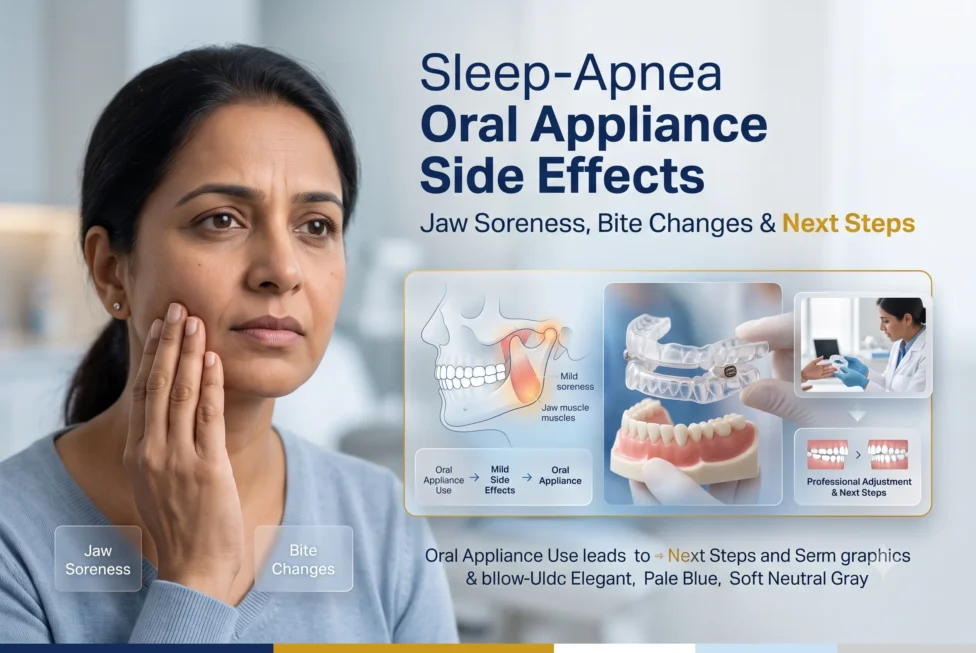
Mild jaw or tooth soreness, extra saliva, dry mouth and a temporary morning bite change can occur when you begin a sleep-apnea oral appliance. Symptoms that worsen, persist, affect chewing or opening, leave your bite altered, damage the mouth or involve a loose or cracked device need professional review. Do not file, heat, bend or advance the appliance yourself, and do not abandon sleep-apnea treatment without a replacement plan.
Your mouthpiece may be helping your snoring, yet your jaw feels sore or your teeth meet differently when you wake. Some early effects can be managed; others mean that fit, advancement, the teeth or the jaw joints need attention. The goal is to recognise the pattern, protect your mouth and keep obstructive sleep apnea treated.
| What to do today
1. Keep the device unchanged. Do not turn its advancement mechanism, file an edge, heat, bend or boil it unless your treating dentist has specifically instructed you. 2. Record the symptom. Note where it occurs, when it starts, how long it lasts, and whether your bite returns to normal. 3. Contact the treating dentist if it persists or worsens. Bring the appliance to the appointment. 4. Protect sleep treatment. If a serious symptom means you cannot wear the device, promptly contact the dental sleep and medical sleep teams about an alternative plan. 5. Put driving safety first. If you are too sleepy to drive safely, do not drive. Move to a safe place and seek prompt clinical advice. |
Oral appliance side effects at a glance
| Symptom | May be manageable early | Contact your dentist promptly | Urgent action |
| Jaw or teeth | Mild muscle tenderness, tooth pressure or stiffness that eases after the appliance is removed | Pain that persists, worsens, disrupts eating or limits opening; a tooth becomes mobile or very sensitive | Jaw stuck open after removal; major trauma, rapidly increasing swelling or breathing/swallowing difficulty |
| Bite | A brief morning feeling that the teeth do not meet normally, then the usual bite returns | The bite does not return as usual, changes progressively or affects chewing | Sudden major bite change after injury, or inability to close the mouth normally |
| Mouth or device | Temporary extra saliva, dry mouth, mild pressure or short-lived gum awareness | Persistent sores, bleeding, loose restoration, sharp edge, poor fit, crack or appliance distortion | A broken piece is swallowed or inhaled, or swelling suggests a serious allergic reaction |
| Sleep symptoms | Snoring changes alone do not prove whether treatment is fully effective | Snoring, witnessed pauses or daytime sleepiness persist or return; arrange sleep-team review | If you feel too sleepy to drive safely, do not drive; get to a safe place and seek prompt clinical advice |
This table is a triage guide, not a diagnosis. Your health, teeth, device and prescription can change what is appropriate. If uncertain, contact the clinician who fitted it.
Why can a sleep-apnea mouthpiece cause symptoms?
A mandibular advancement device holds the lower jaw forward to help keep the airway open. That position loads the teeth, supporting tissues, chewing muscles and jaw joints. The mouth may also respond with extra saliva or dryness. Fit and titration matter: local pressure, rapid advancement, new dental work, wear or damage can make a previously comfortable appliance need review.
Jaw soreness and TMJ pain: what is common, and what is not?
Mild muscle tenderness can occur early. In one two-year randomized trial, pain-related TMD was recorded early in 24% of oral-appliance users versus 6% of CPAP users; the effects were generally temporary, not serious and did not limit jaw function. This is one trial, not a rate that predicts every patient.
A TMD history does not automatically rule out treatment. A 2019 systematic review found no significant worsening of pre-existing TMD signs and symptoms across the included studies, but individual assessment still matters.
Seek review when pain strengthens, lasts through the day, affects eating or comes with reduced opening, catching or locking. A jaw stuck open, significant trauma, rapid swelling, or breathing or swallowing difficulty needs urgent care.
Bite changes: temporary morning shift versus lasting change
Some users notice that the back teeth do not meet normally just after removal. If the familiar bite returns during the morning, this may be an adaptation effect. Follow only the morning routine supplied by your dentist; do not force the jaw into position.
A bite that takes longer to return, does not return or changes chewing needs review. Long-term evidence reports mainly dental changes, including reduced overjet and overbite. Your clinician may compare current findings with baseline records and consider monitoring, a prescribed morning routine, an appliance adjustment or another therapy. Reversal cannot be promised; benefits and oral effects must be weighed together.
What can the treating dentist check or adjust?
| What is reviewed | Why it matters |
| Fit and pressure points | A local pressure area can cause tooth, gum or soft-tissue discomfort and may need professional adjustment. |
| Advancement and titration | The amount and pace of lower-jaw advancement can influence comfort and treatment response. |
| Jaw function and bite | Opening, tenderness, muscle function and occlusion can be compared with baseline and previous visits. |
| Teeth, gums and restorations | The dentist checks mobility, sensitivity, gum health, retention and damage to crowns or fillings. |
| Device condition and sleep control | A worn or damaged device may fit poorly; symptoms and objective sleep testing help determine whether therapy remains effective. |
AASM-AADSM guidance recommends qualified-dentist oversight for dental side effects and bite changes. The correct response depends on the finding; simply increasing or reducing advancement does not solve every symptom.
Do not self-modify the device
A custom appliance is a prescribed medical device. Filing, heating or bending can alter fit; turning its mechanism changes both comfort and jaw position. A cracked or loose appliance can injure tissues or create a swallowing risk. Do not combine it with an unrelated nightguard unless your treating dentist approves the design.
Should you stop wearing the appliance tonight?
Mild effects may be manageable, while severe pain, injury, a damaged device or a major bite problem may make wearing it unsafe until reviewed. Ask the treating dentist for case-specific instructions.
Stopping can leave sleep apnea untreated. AADSM consensus advice calls for medical consultation when oral appliance therapy is permanently discontinued so an alternative is available. If an acute problem prevents use, promptly ask the sleep team what to do; a shop-bought mouthpiece or snoring app is not an equivalent substitute.
Comfort does not confirm that sleep apnea is controlled
A comfortable appliance can still be under-titrated, and less snoring does not prove that breathing events or oxygen changes have resolved. AASM-AADSM guidance suggests follow-up sleep testing to confirm efficacy. The dental sleep clinician manages fit and oral effects; the sleep physician oversees the medical diagnosis and sleep-apnea plan.
Oral-appliance review in Noida
Airway TMJ & Sleep Center can review a custom appliance, jaw and tooth symptoms, the bite and device condition within a dental and medical sleep pathway. Bring the appliance, previous sleep-study reports and recent dental-treatment details.
Learn more about oral appliance therapy for sleep apnea, review TMJ symptoms and warning signs, or contact the clinic to request an appliance review and discuss sleep-physician follow-up.
| Request an appliance review
Call +91 87566 15325. Airway TMJ & Sleep Center, C-98/10, C Block Market, Sector 41, Noida 201301. Bring the device and your sleep-study information; do not alter the appliance before the visit. |
The bottom line
Mild early soreness, saliva changes or a temporary morning bite shift may respond to clinician-guided management. Worsening pain, persistent bite change, sores, tooth or restoration problems, and a damaged device need review. Keep the appliance unchanged, document the pattern, contact the dentist, and reassess sleep-apnea control when indicated.