
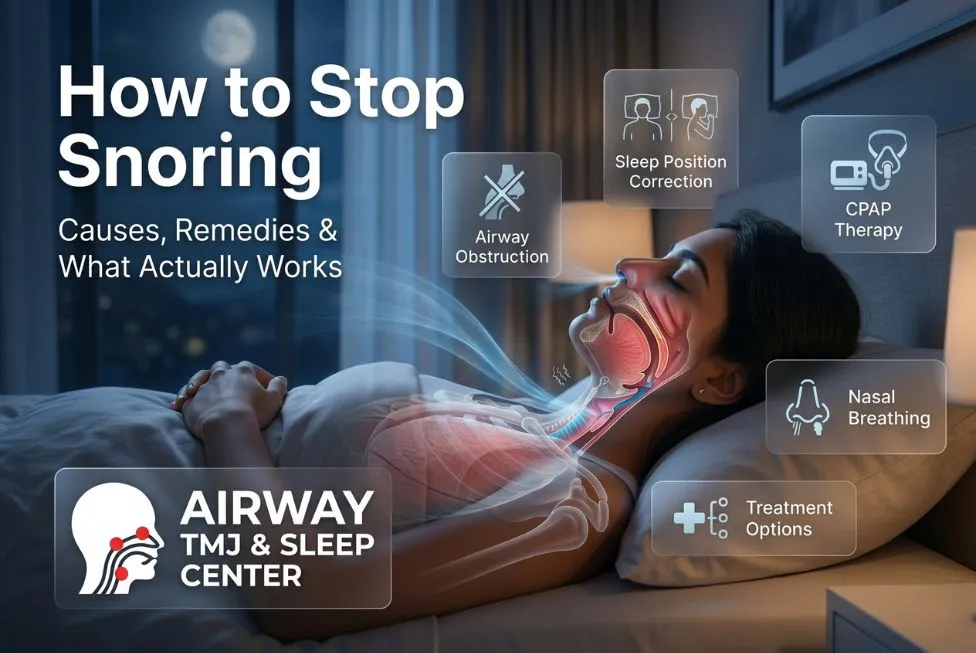
How to Stop Snoring: Causes, Remedies, and What Actually Works
Snoring is one of those problems that affects two people at once – the person who snores, and the partner lying awake beside them. It’s incredibly common, usually harmless on its own, and often very fixable. But it can also be the body’s way of flagging something more serious, like sleep apnea, so it’s worth understanding rather than just enduring.
This guide covers everything: why you snore, how to stop it tonight, the lifestyle changes and natural remedies that genuinely help, the anti-snoring devices worth knowing about, and – importantly – when snoring is a warning sign you shouldn’t ignore.
Quick answer: Snoring happens when air can’t flow freely through a relaxed, narrowed airway, making the surrounding tissues vibrate. The fastest fixes are sleeping on your side, clearing a blocked nose, avoiding alcohol before bed, and elevating your head. For persistent snoring, a custom oral appliance that gently moves the lower jaw forward is one of the most effective, comfortable solutions. If you also gasp or stop breathing in your sleep, see a specialist – that can be sleep apnea.
| Key takeaways
✓ Snoring is caused by narrowed, relaxed airways – often the tongue or jaw falling back, congestion, or alcohol. ✓ Side-sleeping, clearing your nose, skipping alcohol before bed, and weight management are the simplest fixes. ✓ For ongoing snoring, a custom oral appliance (which moves the jaw forward) is highly effective and easier than CPAP. ✓ Loud snoring with gasping, pauses, or daytime exhaustion can signal sleep apnea – get it checked. ✓ There’s no single ‘cure’, but most people can reduce or stop snoring by treating the cause. |
Why Do You Snore?
Snoring is simply the sound of vibrating tissue. When you fall asleep, the muscles in your throat and mouth relax. If your airway is already narrow – or relaxes too much – the air you breathe has to squeeze through, making the soft tissues at the back of the throat flutter and vibrate. The narrower the passage, the louder the snore. Common reasons the airway narrows:
- The tongue and jaw fall back. During deep sleep, a relaxed tongue and a jaw that sits too far back can crowd the airway – a key, often-overlooked cause.
- Nasal congestion. A blocked nose, allergies, or a deviated septum force you to breathe through the mouth and narrow the airflow.
- Relaxed throat tissue. A thick or low soft palate, or extra tissue around the throat, vibrates easily.
- Alcohol and sedatives. They over-relax the airway muscles, making snoring worse – especially within a few hours of bedtime.
- Sleeping on your back. Gravity pulls the tongue and soft tissues backward, blocking the airway.
- Weight and age. Extra neck tissue and naturally looser muscles with age both contribute.
| Stop snoring tonight – quick wins
✓ Sleep on your side, not your back (a pillow behind you helps you stay there) ✓ Clear your nose before bed – saline rinse, a hot shower, or a nasal strip ✓ Raise the head of your bed or use an extra pillow to open the airway ✓ Skip alcohol for at least 3 hours before sleep ✓ Stay hydrated – dry airways vibrate more |
Natural Remedies and Lifestyle Changes
For many people, snoring improves significantly with a few sustained habits – no devices required:
- Side-sleeping. One of the most effective single changes for people who snore mainly on their back.
- Manage your weight. Losing even a little excess weight reduces tissue around the neck and throat that narrows the airway.
- Treat nasal congestion. Saline rinses, managing allergens in the bedroom, and a humidifier keep the nose clear so you breathe through it.
- Cut evening alcohol and sedatives. Avoid them close to bedtime so your airway muscles don’t over-relax.
- Keep a regular sleep routine. Over-tiredness deepens muscle relaxation and worsens snoring.
- Quit smoking. It irritates and inflames the airway, making snoring worse.
Anti-Snoring Devices: What Works
When habits aren’t enough, devices can make a real difference. Here’s how the main options compare.
| Option | How it helps | Best for |
| Nasal strips / dilators | Open the nostrils to ease nasal airflow | Snoring driven mainly by a blocked nose |
| Positional aids | Keep you off your back | Back-only snorers |
| Custom oral appliance (MAD) | Gently moves the lower jaw forward to open the airway and stop the vibration | Most persistent snoring; a comfortable CPAP alternative |
| Over-the-counter mouthpieces | Similar idea, but generic fit | A short-term trial; less precise and durable |
| CPAP machine | Pumps pressurised air to hold the airway open | Moderate-to-severe sleep apnea |
Why a custom oral appliance stands out: a mandibular advancement device is moulded to your teeth and adjusted to move your lower jaw slightly forward, which opens the throat and stops the tissues vibrating. Research shows these are effective for snoring, and people tend to use them consistently for years – they’re quiet, portable, need no electricity, and are far easier to live with than a CPAP mask. The key is having one professionally fitted, so it’s comfortable and actually targets your airway.
Snoring vs Sleep Apnea: Know the Difference
This is the part that matters most for your health. Plain snoring is the sound of a partly narrowed airway. Sleep apnea is when the airway repeatedly closes almost completely, so you briefly stop breathing – over and over, all night. Snoring can be harmless, but loud, chronic snoring is also the most common sign of obstructive sleep apnea.
| See a doctor if your snoring comes with
✓ Gasping, choking, or pauses in breathing during sleep (often noticed by a partner) ✓ Waking unrefreshed and feeling exhausted or foggy during the day ✓ Morning headaches, a dry mouth, or a sore throat on waking ✓ High blood pressure, or falling asleep easily during the day ✓ Very loud snoring that disrupts your or your partner’s sleep nightly |
If any of these sound familiar, it’s worth getting assessed – read more about sleep apnea and how it’s treated, and consider a sleep evaluation.
Which Doctor Should You See for Snoring?
For occasional snoring, lifestyle changes are usually enough. For persistent snoring – or if you suspect sleep apnea – the right help comes from a sleep specialist or a dental sleep medicine practice. These professionals can assess your airway, arrange a sleep study if needed, and fit a custom oral appliance. A dental sleep approach is especially useful when the jaw and airway are part of the problem, which they very often are.
Why Choose Airway TMJ & Sleep Center in Noida
Snoring is, at its heart, an airway problem – and often a jaw-position problem too. That’s exactly the focus at Airway TMJ & Sleep Center in Noida. Dr. Kishlay Gaur assesses how your jaw, airway, and breathing work together, and designs custom oral appliances that gently reposition the jaw to keep your airway open through the night. The result is quieter, deeper sleep – for you and whoever shares your room – and, where snoring points to something more, the right onward care.
The Bottom Line
Snoring is common and usually treatable. Start with the simple wins – side-sleeping, a clear nose, no late alcohol, an elevated head – and build in the lifestyle changes that last. If snoring persists, a professionally fitted oral appliance is one of the most effective and comfortable solutions available. And if your snoring comes with gasping, pauses, or daytime exhaustion, don’t wait – that’s your cue to get checked for sleep apnea. Quieter nights, and better health, are well within reach.
Book a snoring and sleep assessment in Noida to find out why you snore and the simplest way to stop – including a custom oral appliance.