
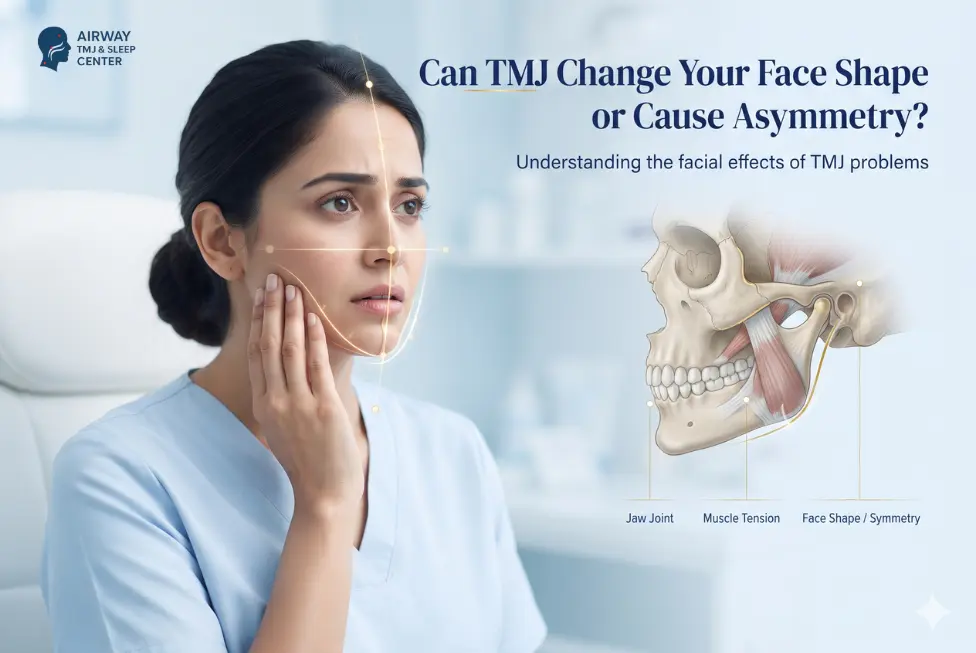
TMJ disorders can sometimes make the face look temporarily uneven through muscle guarding, altered jaw posture or swelling. Ordinary TMD does not usually reshape facial bone. A progressively changing bite, chin position, jawline or facial asymmetry may signal a structural joint or jaw condition and deserves examination and selected imaging. Similar-looking selfies do not establish the cause.
Can TMJ really change your face shape?
‘TMJ’ is the joint; ‘TMD’ describes disorders of the jaw joints, chewing muscles and related structures. Many TMDs cause pain, stiffness, clicking or limited movement without changing the facial skeleton.
A 2021 systematic review found greater chin deviation in people with unilateral TMJ disorders, but it included only seven cross-sectional studies and the evidence was low-certainty. It cannot show which condition came first or whether another factor affected both.
Uncommon conditions—including one-sided condylar growth, condylar resorption, destructive joint disease and trauma—can alter structure over time. They require a separate diagnosis and are not the expected outcome of routine TMD.
Temporary-looking versus progressive change
| What you notice | What it may reflect | Useful next step |
| Different only in selfies | Close camera distance, lens choice, head rotation, lighting, expression or image mirroring. | Repeat a standardized photograph; do not diagnose change from two unlike images. |
| Varies with pain or through the day | Muscle guarding, altered jaw posture or soft-tissue swelling may temporarily change contour or movement. | Record timing, pain, opening, bite and swelling; seek assessment if it persists or recurs. |
| One jaw angle looks fuller | Normal soft-tissue variation, muscle size, salivary/dental swelling or another local cause—not automatically clenching. | Clinical examination before cosmetic treatment or assuming masseter hypertrophy. |
| Bite or chin is progressively shifting | A structural jaw/TMJ process such as condylar growth, resorption, arthritis, trauma or another condition may need exclusion. | Prompt dental/TMJ, orthodontic or maxillofacial assessment with question-led imaging. |
| Sudden droop, numbness, mass or major swelling | Neurological, infectious, traumatic or other non-TMD causes can change appearance. | Use the urgent or emergency pathway below; do not wait for a routine TMJ visit. |
Why muscles or swelling can change the way the jaw looks
Pain can make a person hold the jaw to one side, limit opening or tense the chewing muscles, changing expression or contour. Swelling can do the same, but dental, salivary, skin and other causes must be considered.
Jaw width does not prove clenching. In an ultrasound study of 115 people, masseter thickness varied with sex and facial morphology but not significantly with reported parafunctional habits. A photo cannot measure muscle activity.
Structural patterns that should not be dismissed as cosmetic
Progressive condylar growth
Unilateral condylar hyperplasia is uncommon. Continued growth on one side may gradually shift the chin, tilt the bite plane and create malocclusion. Diagnosis requires a time course, examination and specialist-selected imaging—not visual judgement alone.
Condylar resorption or loss of joint height
Idiopathic condylar resorption is also uncommon. Loss of condylar or ramus height can contribute to lower-jaw retrusion, an opening bite at the front or increasing asymmetry. Similar change may follow systemic disease, surgery or trauma, so ‘idiopathic’ is used only after other causes are excluded.
Bite change without obvious facial change
A progressive change in tooth contact may be a more objective clue than appearance. Bring older dental records or retainers; do not force the jaw into position for comparison.
| Do not wait for a routine TMJ appointment
Emergency now: sudden facial droop or numbness with arm weakness, speech or vision difficulty, loss of balance or severe unexplained headache; trouble breathing or swallowing; rapidly spreading swelling; serious facial trauma, heavy bleeding, collapse/confusion; or a jaw stuck open and unable to close. Same-day urgent assessment: fever with new facial or jaw swelling, redness or warmth; pus or suspected dental infection; sudden major bite change after injury; new facial numbness; or rapidly worsening pain and opening. Prompt specialist assessment: asymmetry that is visibly progressing, a new or increasing open bite, chin or jawline shift, lower-jaw retrusion, a growing or persistent lump, or progressive change in a child or adolescent. |
Why before-and-after photos can mislead
Short camera distance changes perspective. In a small 2024 study, selected settings produced 12%–19% vertical stretching of midfacial features. Head position, expression, mirrored images and lighting add more variation.
Two unmatched selfies cannot prove bone change or treatment ‘reversal.’ Photos can document a pattern; they are not a home diagnostic test.
A standardized face-photo guide
| Step | Keep constant | Practical instruction |
| 1 | Camera and lens | Use the same device and main/rear camera at the same setting. Avoid ultra-wide mode, filters, beauty correction and portrait reshaping. |
| 2 | Distance and height | Mount or steady the phone at eye level and mark a repeatable camera-to-person distance. Avoid close arm’s-length selfies. |
| 3 | Head and jaw position | Stand upright, look at a distant eye-level point, keep the head unrotated, and let the jaw and lips rest naturally without clenching. |
| 4 | Views and lighting | Use even front lighting and a plain background. Take a relaxed front view and both profiles; add a smile only as a separate consistent view. |
| 5 | Context and privacy | Date each set and note pain, swelling, bite and movement. Store privately and bring the original images—not screenshots—to the clinician. |
Take a baseline set and repeat only after a distinct change or at a clinician-agreed interval. Calibrated clinical photographs are more reliable than home images.
When does imaging help?
Imaging depends on the suspected cause and whether the result would change care. ADA–AAOMR guidance places history and examination first.
| Assessment | Question it answers | Important limit |
| History, examination and records | Is the difference new, progressive, functional, painful, dental, muscular, neurological or skeletal? | This comes first. A photo or scan finding without a matching clinical pattern may mislead. |
| Panoramic / cephalometric imaging | Broad dental, jaw and skeletal relationships when clinically indicated. | Two-dimensional views can hide depth and rotation; they do not answer every TMJ question. |
| CBCT / CT | Three-dimensional bony shape, condyles, asymmetry, fracture, remodelling or resorption. | Uses ionising radiation and should be selected only when the result can affect care. |
| MRI | Disc, joint fluid, inflammation and other soft-tissue questions. | Not a routine ‘face-shape scan’ and not the best test for every bony question. |
| Specialist functional imaging | Whether suspected abnormal condylar growth is active in selected cases. | SPECT or related testing is specialist-selected; it is not screening for ordinary TMD or mild asymmetry. |
What treatment can—and cannot—promise
- Treat the cause, not the photograph. Pain, swelling, muscle guarding, dental infection and structural disease require different plans.
- Do not assume cosmetic reversal. Improved comfort or jaw function may change posture or expression, but perfect symmetry cannot be promised.
- Escalate structural concerns. Appliances or orthodontics need a defined indication; progressive change may require specialist input first.
Face-shape and jaw-asymmetry assessment in Noida
Airway TMJ & Sleep Center can compare the timeline with movement, bite, muscle and joint findings, review previous records and decide whether imaging or referral is appropriate. The aim is function and cause—not diagnosis from a selfie.
Review the TMJ symptoms and warning signs guide, use the jaw swelling location guide when fullness or a lump is present, or contact the clinic for an assessment.
| Bring comparable photos and earlier dental records
Call +91 87566 15325. Airway TMJ & Sleep Center, C-98/10, C Block Market, Sector 41, Noida 201301. Sudden neurological symptoms, airway difficulty, serious trauma or spreading swelling need emergency care—not a routine clinic appointment. |
The bottom line
TMJ pain can temporarily affect jaw posture or contour, but routine TMD does not usually reshape the face. Photos can exaggerate asymmetry, and research does not prove a simple one-way cause.
Focus on change over time: a progressive bite, chin or jawline shift deserves structured examination and question-led imaging. Standardized records help separate soft tissue, function and skeletal change.