
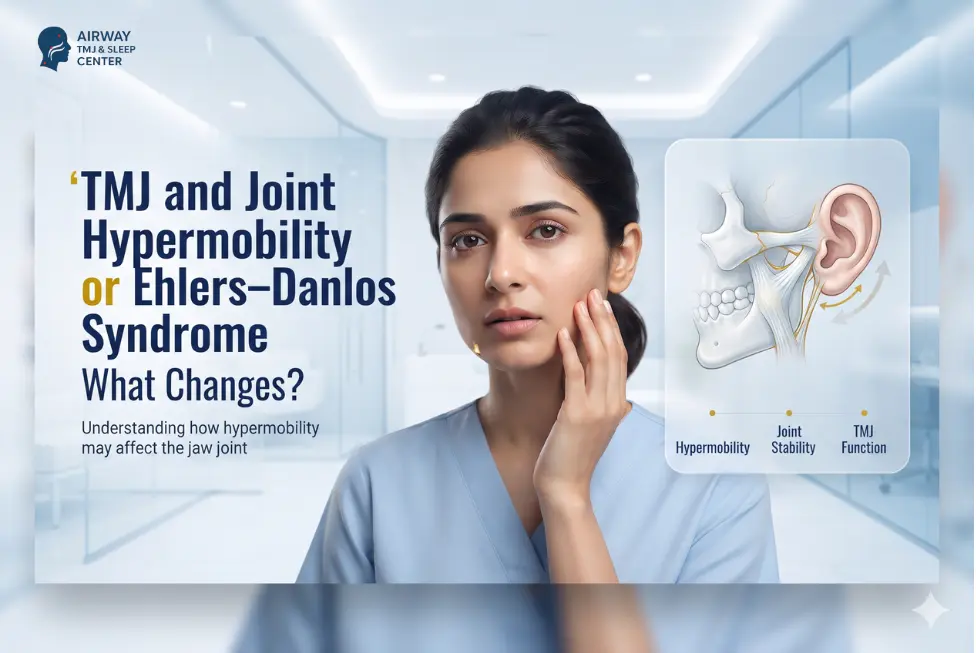
Having hypermobile Ehlers–Danlos syndrome (hEDS), a hypermobility spectrum disorder (HSD) or generalized joint hypermobility may change how TMJ symptoms are assessed. Recurrent slipping, fixed dislocation, other joint instability and procedure triggers deserve attention. However, a click, wide opening or jaw pain cannot diagnose EDS, and not every hypermobile person has a TMJ disorder. Research is heterogeneous and no single hypermobility-specific TMJ protocol has been established.
What does ‘hypermobility’ mean for the jaw?
Joint hypermobility means a joint moves beyond the range expected for many people. It can be localized, generalized, symptom-free or associated with instability and pain. HSD is diagnosed when symptomatic hypermobility cannot be better explained by another condition. EDS is a group of heritable connective-tissue disorders with subtype-specific criteria.
The TMJ already combines rotation and forward translation. A large movement can therefore look dramatic without being a fixed dislocation. Because research uses inconsistent definitions for TMJ hypertranslation, the clinician needs a precise history rather than a single label.
| Term | What it means | Why the distinction matters |
| Joint hypermobility | A joint moves beyond the range expected for many people. It may be painless and stable. | Extra range alone is not a disorder and does not prove EDS, HSD or TMD. |
| TMJ hypertranslation | The condyle travels far forward during opening and returns. Definitions vary across studies. | A wide opening or visible movement is not automatically painful instability. |
| Subluxation | A temporary slip that returns spontaneously or can be self-reduced. | Record the trigger, duration and frequency; repeated episodes need assessment. |
| Dislocation | A fixed displacement: the jaw is typically stuck open and cannot close normally. | This needs prompt professional reduction. Do not copy an online manoeuvre. |
| Closed lock | Opening is restricted rather than fixed open; causes include disc and muscle problems. | It is different from dislocation and needs a different examination and plan. |
What does the research actually show?
A 2023 systematic review found TMJ manifestations were frequently reported in EDS studies, particularly disc-related disorders and joint hypermobility. Yet it included only 12 heterogeneous articles, and the prevalence estimates varied so widely that one headline percentage would be misleading.
A 2025 scoping review examined 54 sources on generalized joint hypermobility, TMJ hypertranslation and TMD. Some studies suggested an association, while others did not; the authors found no consensus because diagnostic definitions and methods differed. A 2024 review also found no long-term clinical trials establishing the best TMD treatment for EDS.
The useful conclusion is modest: connective-tissue context may matter, but it does not prove that hypermobility caused every click, headache or pain flare. Muscle pain, disc disorders, arthritis, dental disease and sensitized pain may still need separate evaluation.
A history checklist for your TMJ appointment
Bring a short timeline rather than demonstrating extreme opening. The details below help the clinician decide whether the main issue is pain, disc mechanics, recurrent instability or another condition.
| History to share | Useful detail | Why it changes care |
| Jaw episodes | Click, painful catch, self-reducing slip, locked open or unable to open; side and duration. | Separates common sounds, disc problems and possible instability. |
| Triggers and pattern | Yawning, chewing, vomiting, singing, trauma, dental work, endoscopy or intubation; frequency over time. | Identifies preventable triggers and whether episodes are becoming recurrent. |
| Whole-body history | Diagnosed hEDS, HSD or another EDS type; other joint instability, dislocations, sprains and relevant family history. | Places the jaw problem in connective-tissue and medical context. |
| Procedure experience | Previous jaw support needs, prolonged-opening symptoms, bleeding or wound concerns, and any anaesthetic difficulties. | Helps the team plan positioning, breaks and medical coordination. |
| Function and recovery | Comfortable opening, eating and speaking limits, bite change, pain flare length and what helps. | Sets a functional baseline without repeatedly forcing maximum range. |
| Records and care team | Diagnosis letter, medication list, imaging, previous treatment and relevant clinician contacts. | Reduces duplicated testing and improves coordinated decisions. |
Easy bruising, stretchy skin, family history or other joint symptoms may be medically relevant, but no item in this table diagnoses hEDS, HSD or another EDS type. Ask a clinician experienced in heritable connective-tissue disorders when a medical assessment is appropriate.
How assessment may be adapted
History and examination come first. The clinician can observe comfortable opening and closing, deviation, bite, muscle and joint tenderness, sounds and functional limits without repeatedly forcing maximum range. A known tendency to dislocate should be stated before any provocative manoeuvre.
Imaging is question-led, not automatic. It may be considered after trauma, persistent bite change, recurrent fixed dislocation, suspected bony damage or a soft-tissue question that would change care. A scan can assess the jaw; it cannot confirm or exclude hEDS or HSD.
Conservative care: what may change
| Goal | Possible adaptation | Important limit |
| Reduce provocation | During a flare, use smaller bites and avoid the specific end-range trigger that causes slipping. | This is temporary load management, not permanent fear of normal movement. |
| Improve control | Use clinician-guided, low-load control and stabilization work with gradual functional progression. | Avoid aggressive stretching, repeated maximum opening or exercises that chase a click. |
| Treat the pain source | Distinguish muscle pain, joint inflammation, disc problems, dental pain and instability before choosing care. | A hypermobility label does not explain every facial pain episode. |
| Use an appliance selectively | Consider only for a defined indication, with symptom, opening and bite monitoring. | A splint cannot tighten connective tissue or guarantee prevention of dislocation. |
| Escalate recurrent instability | Seek oral/maxillofacial or TMJ input when fixed or self-reducing episodes recur or increase. | Procedures or surgery are individualized and not automatic because EDS is present. |
NIDCR guidance for TMD generally favours simple, conservative and reversible care before treatments that permanently change the bite or joint. In hypermobile patients, the exact movement dose and appliance decision should be individualized rather than copied from a generic exercise video.
Plan ahead for dental and medical procedures
Tell the dentist, surgeon, anaesthetist or endoscopy team about diagnosed or suspected hypermobility and any previous jaw dislocation. Share the trigger, whether professional reduction was needed, and what positioning or breaks helped. Prolonged maximum opening can be a relevant procedural trigger in susceptible patients.
- Agree on a comfortable opening range and use jaw support or short pauses when the procedure allows.
- Do not generalize across all EDS types. Bleeding, wound healing, anaesthetic response and other risks vary; the team should use your diagnosis and personal history.
- Have a plan if the jaw locks open. Know who will assess it; do not attempt a forceful self-reduction unless a qualified clinician has given you a personal plan.
| When to seek urgent care
Emergency or urgent assessment now: the jaw is stuck open and you cannot close it; breathing or swallowing is difficult; there is serious facial trauma, uncontrolled bleeding, collapse/confusion, or sudden facial weakness/numbness with other neurological symptoms. Same-day assessment: a major new bite change after injury, severe facial or jaw swelling with fever, pus or suspected dental infection, new numbness, or rapidly worsening pain and function. Prompt specialist review: self-reducing slips or fixed dislocations are recurring, episodes happen during ordinary opening, frequency is increasing, or the bite and function are progressively changing. |
Hypermobility-aware TMJ assessment in Noida
Airway TMJ & Sleep Center can document the episode pattern, compare muscle, joint, disc and bite findings, review existing medical information, and decide whether imaging or another referral is appropriate. The goal is a functional, coordinated plan—not to diagnose EDS from the jaw or promise that one appliance will stabilize every case.
Review the TMJ symptoms and warning signs guide, read the TMJ home-care overview with the caution that hypermobile joints may need tailored exercises, or contact the clinic for an assessment.
| Bring your episode timeline and medical context
Call +91 87566 15325. Airway TMJ & Sleep Center, C-98/10, C Block Market, Sector 41, Noida 201301. A jaw stuck open, airway difficulty, major trauma or acute neurological symptoms needs urgent or emergency care—not a routine clinic appointment. |
The bottom line
hEDS, HSD or generalized joint hypermobility can change the questions asked and the precautions used, especially when slipping or dislocation recurs. It does not turn every click into instability or provide a diagnosis by itself.
Name the episode accurately, share whole-body and procedure history, avoid forceful end-range testing, and use a conservative plan matched to function. Recurrent fixed or self-reducing episodes deserve coordinated specialist assessment.