
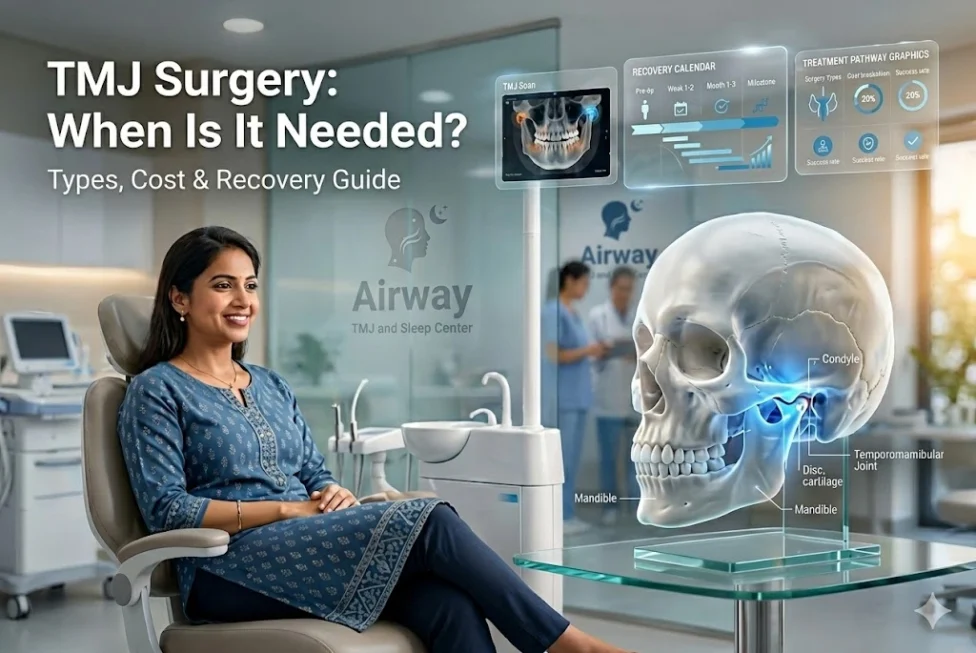
If you’ve been struggling with jaw pain and the word ‘surgery’ has started to creep into your searches, take a breath. Here’s the single most important thing to know up front: most people with a TMJ disorder never need surgery. Studies consistently show that around 85 to 90 percent of cases improve with non-surgical, conservative care alone. Surgery is the exception, not the rule – reserved for a small number of severe or stubborn cases.
That said, it’s natural to want to understand all your options. This guide walks you through when TMJ surgery is actually needed, the different types and how invasive they are, what they cost in India, recovery times and success rates – and, just as importantly, the non-surgical treatments that should always come first.
Quick answer: TMJ surgery is only considered when conservative treatments have failed and there’s a clear structural problem – like a jaw that won’t open, a locked or dislocated joint, or significant joint damage. The main types, from least to most invasive, are arthrocentesis, arthroscopy, open-joint surgery, and total joint replacement. Around 85-90% of people get better without any surgery at all.
| Key takeaways
✓ Most TMJ disorders (about 85-90%) are resolved without surgery. ✓ Surgery is reserved for severe cases that don’t respond to conservative care, or for clear structural damage. ✓ There are four main options, from minimally invasive (arthrocentesis) to total joint replacement. ✓ Minimally invasive procedures have high success rates and short recovery; open surgery is rare. ✓ Always exhaust non-surgical options – appliances, therapy, bite correction – before considering surgery. |
First: Do You Actually Need Surgery?
For the vast majority of people, the honest answer is no. Conservative, reversible treatments – a custom oral appliance, jaw physiotherapy, stress and habit changes, and bite correction where needed – resolve most TMJ symptoms. These should always be tried thoroughly first, because they’re effective, low-risk, and don’t involve operating on the joint.
Surgery only enters the conversation when two things are true: conservative care has been given a fair trial and hasn’t worked, and there’s a specific structural problem in the joint that surgery can actually fix. Without a clear surgical target, an operation is unlikely to help – which is why a careful diagnosis matters so much before anyone reaches for the scalpel.
When Is TMJ Surgery Needed?
Surgery may be considered when symptoms are severe and persistent despite proper non-surgical treatment, and imaging shows a problem that can be corrected. Typical situations include:
- A jaw that locks or can’t open properly, severely limiting eating and speaking.
- A persistently displaced disc that hasn’t responded to conservative care.
- Significant joint degeneration, arthritis, or structural damage seen on imaging.
- A dislocated jaw that keeps recurring, or ankylosis (the joint fusing and stiffening).
- Severe, disabling pain that conservative treatment has genuinely failed to relieve.
The Types of TMJ Surgery (Least to Most Invasive)
TMJ surgery isn’t one operation – it’s a ladder of options, and the goal is always the least invasive procedure that will do the job. Here’s how they compare.
| Procedure | What it involves | Recovery | Notes |
| Arthrocentesis | Minimally invasive: the joint is flushed with fluid through needles to remove debris and reduce inflammation | Days to ~1 week | Often first-line; high success (around 80-84% improvement) |
| Arthroscopy | Keyhole surgery: a tiny camera and instruments enter the joint through a small cut to wash, repair the disc, or remove spurs | About 1-2 weeks | Minimally invasive; roughly 75-90% report improvement |
| Open-joint surgery (arthrotomy) | A larger incision lets the surgeon directly repair, reposition, or remove damaged parts of the joint | About 2-6 weeks | Reserved for clear structural damage; more involved |
| Total joint replacement | The damaged joint is replaced with a prosthetic | Several weeks to months | For severe degeneration, ankylosis, or failed prior surgery |
TMJ Surgery Cost in India
Cost depends heavily on the type of procedure, the surgeon, the hospital, and your individual case – so treat the figures below as broad, approximate ranges for planning, not a quote. As a rule, the less invasive the procedure, the lower the cost.
| Procedure | Approximate cost in India (INR) |
| Arthrocentesis (minimally invasive) | Lowest – typically a few tens of thousands of rupees |
| Arthroscopy (keyhole) | Moderate |
| Open-joint surgery / total replacement | Highest – often around Rs 1.5 lakh to Rs 7 lakh+ |
Important: these ranges are indicative only and vary widely by case and centre. The most useful number is the one you get after a proper diagnosis – and remember, the conservative treatment most people actually need costs a fraction of surgery.
Recovery and Success Rates
Recovery tracks closely with how invasive the procedure is. Minimally invasive options like arthrocentesis and arthroscopy often mean a return to normal activities within days to a couple of weeks, with a soft diet and gentle jaw movement in between. Open-joint surgery and joint replacement involve a longer recovery – typically several weeks, sometimes longer for full healing – and usually a course of physiotherapy afterwards.
Success rates are encouraging for the less invasive procedures: arthrocentesis averages around 80-84% improvement, and arthroscopy reports roughly 75-90%. As with any surgery, results depend on choosing the right procedure for the right problem – which again comes back to an accurate diagnosis.
| Non-surgical treatments to try first
✓ Custom oral appliance (splint or night guard) to unload the joint and reduce clenching ✓ Jaw physiotherapy and targeted exercises to restore movement ✓ Bite correction or neuromuscular treatment where an uneven bite is the cause ✓ Stress management and habit change to ease muscle tension ✓ Anti-inflammatory measures and short-term pain relief during flares |
Is TMJ Curable Without Surgery?
For most people, yes – in the sense that they can become and stay symptom-free with consistent, non-surgical treatment. Around 85 to 90 percent of TMJ cases respond well to conservative care. While a TMJ disorder doesn’t always have a single permanent ‘cure’, the great majority of patients achieve lasting relief by treating the underlying cause – the clenching, the muscle tension, the bite imbalance – rather than the joint surgically. That’s exactly why a thorough, root-cause approach is so valuable before surgery is ever discussed.
Why Choose Airway TMJ & Sleep Center in Noida
The most important decision in TMJ care isn’t which surgery – it’s whether you need one at all. At Airway TMJ & Sleep Center in Noida, Dr. Kishlay Gaur takes a firmly conservative, non-surgical approach, using detailed neuromuscular diagnostics to identify the true cause of your symptoms and to treat them at the source. For the overwhelming majority of patients, that means lasting relief without an operation. And if a structural problem genuinely needs surgical input, you’ll get an honest assessment and the right onward guidance – not a rush to the operating table.
The Bottom Line
TMJ surgery is real, effective, and sometimes necessary – but for most people, it’s simply not needed. The evidence is consistent: the large majority of TMJ disorders resolve with conservative, non-surgical care, and surgery is reserved for severe or structural cases that haven’t responded to it. If surgery has been suggested to you, it’s well worth getting a second, conservative-first opinion before committing. More often than not, there’s a simpler path to relief.
Book a TMJ evaluation in Noida for an honest, conservative-first assessment of whether you need surgery – and the simplest way to get relief.