
What Causes TMJ? Why Your Jaw Hurts and How to Fix It
It often starts small. A bit of soreness when you bite into an apple. A tired, achy jaw by the end of a stressful week. Maybe a twinge on one side that you can’t quite explain. Then you find yourself asking the question that brought you here: why does my jaw actually hurt?
It’s a fair question – and a frustrating one, because jaw pain rarely has a single, obvious cause. Most of the time it traces back to a TMJ disorder, where the jaw joint and its muscles are under more strain than they can handle. But not always. This guide breaks down the real reasons your jaw hurts – when you chew, on one side, or all of a sudden – what else it could be, and most importantly, what you can do about each one.
Quick answer: Most jaw pain comes from a TMJ disorder, usually caused by a combination of teeth clenching or grinding, stress, an uneven bite, poor posture, or a past jaw injury – rarely a single factor. Other causes, such as wisdom teeth, a dental infection, or a sinus problem, can mimic it. Identifying the real trigger is the key to lasting relief, and most causes respond well to simple, non-surgical care.
| Key takeaways
✓ Jaw pain is usually a TMJ disorder driven by several factors at once – not one cause. ✓ The biggest culprits: clenching and grinding, stress, an uneven bite, posture, and injury. ✓ Pain when chewing, on one side, or that comes on suddenly each points to slightly different triggers. ✓ Not all jaw pain is TMJ – wisdom teeth, infections, and sinus issues can feel similar. ✓ Pinpointing the real cause is what makes treatment work – and most causes are very treatable. |
First, What’s Actually Happening in Your Jaw?
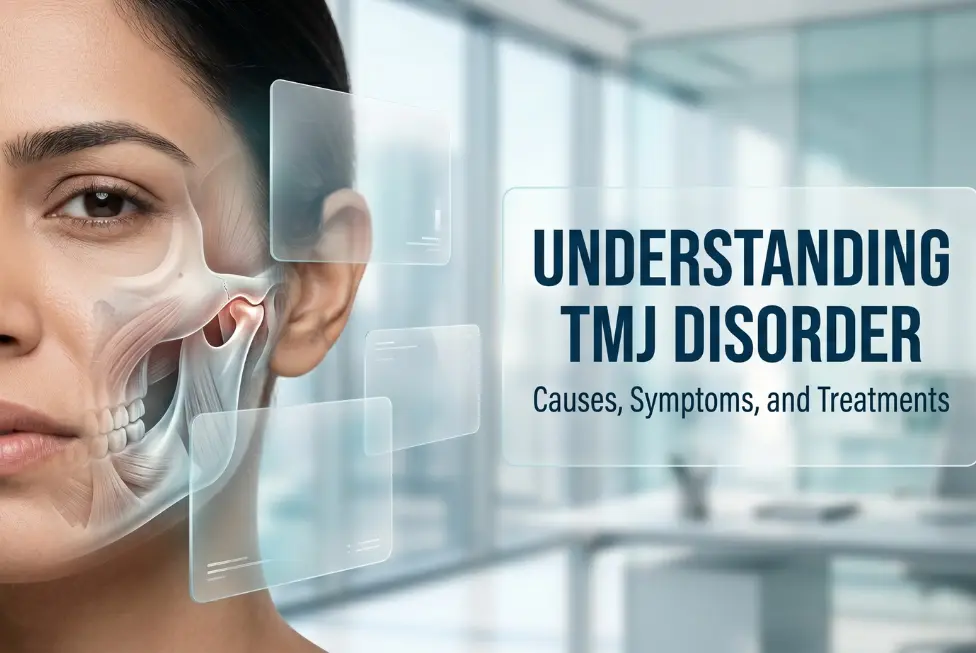
Your jaw joint – the temporomandibular joint, or TMJ – is the hinge in front of each ear that lets you talk, chew, and yawn. A small disc cushions the joint so it glides smoothly. Around it sit powerful muscles that do the heavy lifting of chewing. Pain happens when something throws this system out of balance: the disc slips, the muscles get overworked, or the joint becomes inflamed. The interesting part is how many everyday things can tip that balance – which is exactly what the causes below describe.
The Main Causes of TMJ Disorders
In most people, a TMJ disorder is the result of several of these working together. Here’s each one – and a first step you can take for it.
1. Teeth clenching and grinding (bruxism)
This is the most common driver. Many people clench or grind in their sleep without knowing, putting hours of force on the joint and exhausting the muscles. The tell-tale signs are a tight, sore jaw in the morning, worn teeth, and headaches. The fix usually starts with a custom night guard to absorb that force and break the cycle.
2. Stress and muscle tension
Stress is the quiet engine behind a lot of jaw pain. When you’re tense, you clench – often without realising – and the jaw, face, and neck muscles stay contracted for hours. That’s why symptoms so often flare during busy or anxious periods. Managing stress, and simply noticing daytime clenching, makes a real difference.
3. An uneven bite (malocclusion)
If your upper and lower teeth don’t meet evenly, one side of the jaw ends up doing more work than the other. Over time, that uneven load strains the joint and muscles. People often describe a bite that feels ‘off’. When the bite is the root cause, correcting it is what prevents the pain from returning.
4. Poor posture
Hours hunched over a phone or laptop push the head forward, which pulls on the neck and changes how the jaw rests and moves. This ‘tech-neck’ strain is an underrated cause – and one of the easiest to start improving today.
5. Injury or trauma
A blow to the jaw, a sports injury, whiplash, or even keeping the mouth open for a long dental procedure can shift the joint or its disc out of position. If your pain began after a specific event, this is often why.
6. Arthritis and joint wear
Like any joint, the TMJ can develop inflammation or age-related wear. Arthritis in the joint changes how smoothly it moves and can produce a gritty, grinding sensation rather than a clean click.
Why Does My Jaw Hurt When I Chew?
This is one of the most-searched jaw questions – and it makes sense, because chewing puts the joint and muscles under their heaviest daily load. If chewing hurts, it usually points to one of a few things: overworked or strained chewing muscles (often from clenching), inflammation in the joint, or a displaced disc that the jaw has to work around. Pain that’s worse with hard or chewy foods, and eases with softer ones, strongly suggests the TMJ is involved. The first move is simple: rest the joint with softer foods and smaller bites while you address the underlying cause.
Why Does My Jaw Hurt on One Side?
One-sided jaw pain is extremely common, and it usually doesn’t mean anything sinister. The left and right joints rarely wear evenly – one may carry more load, sit under more muscle tension, or have a disc that’s slipped slightly. Habits like always chewing on one side, or sleeping on the same side every night, concentrate the strain there. If the pain is only on one side and comes with clicking or tenderness in front of the ear, the TMJ on that side is the likely source. It’s worth having checked if it persists, but it’s rarely a cause for alarm.
Why Does My Jaw Feel Tight All of a Sudden?
A jaw that suddenly feels tight, stiff, or hard to open is usually the muscles reacting to a spike in clenching – often triggered by a stressful day, a long dental visit, a big yawn, or a night of heavy grinding. The muscles go into a protective tightness. In most cases gentle warmth, jaw rest, and stress relief settle it within a few days. If the tightness turns into actual locking – where the jaw catches or won’t open fully – that’s a sign to get it assessed sooner rather than later.
Is It Always TMJ? Other Causes of Jaw Pain
Not every aching jaw is a TMJ disorder. A few other conditions can feel very similar, which is why a proper diagnosis matters. Here’s how to tell them apart.
| Possible cause | Typical clues | What usually helps |
| TMJ disorder | Clicking, tight jaw, pain chewing, headaches, worse with stress | Self-care, night guard, jaw therapy |
| Teeth grinding (bruxism) | Morning soreness, worn teeth, partner hears grinding | Custom night guard, stress management |
| Wisdom teeth | Pain at the back of the jaw, gum swelling, often in late teens/20s | Dental assessment; possible removal |
| Dental infection or abscess | Throbbing pain near a specific tooth, sensitivity, swelling | See a dentist promptly |
| Sinus problems | Upper-jaw ache with congestion, worse when bending forward | Treat the sinus issue; often resolves with it |
| Injury | Pain that began after a knock, fall, or whiplash | Get it evaluated, especially if severe |
A note on urgent symptoms: jaw pain with chest pain, shortness of breath, or pain spreading to the arm can – rarely – signal a heart problem and needs emergency care. Likewise, a jaw that locks completely or follows a serious injury should be seen straight away.
Who Is Most Likely to Develop a TMJ Disorder?
TMJ disorders are common, affecting millions of people. They appear most often between the ages of 20 and 40, and women are affected roughly twice as often as men. You’re more likely to develop one if you grind or clench, live with ongoing stress, have an uneven bite, suffer from arthritis, or have had a jaw injury. The more of these that apply, the more worthwhile it is to act early.
What You Can Do About It
The encouraging news is that knowing the cause points straight to the solution. For most people, relief starts with simple steps:
- Rest the joint with softer foods and smaller bites during a flare.
- Use warmth or cold to relax muscles or calm sharp pain.
- Break the clenching habit – keep teeth slightly apart, and manage stress.
- Improve your posture at your desk and on your phone.
- Protect against grinding with a properly fitted appliance if you grind at night.
For step-by-step relief, see our guides on TMJ exercises and home remedies and how to ease a flare-up – and if an uneven bite is the cause, correcting it is what makes the change last.
| See a TMJ specialist if
✓ Your jaw pain is constant, worsening, or stopping you eating and talking normally ✓ Your jaw locks, catches, or won’t open fully ✓ The pain is clearly on one side with clicking and tenderness that won’t settle ✓ You suspect a dental cause – a specific painful tooth or swelling ✓ Self-care hasn’t helped after about two weeks |
Why Choose Airway TMJ & Sleep Center in Noida
Because jaw pain has so many possible causes, the most important thing is finding the right one – and that takes a focused assessment, not guesswork. At Airway TMJ & Sleep Center in Noida, Dr. Kishlay Gaur specialises in TMJ and orofacial pain, using detailed neuromuscular diagnostics to identify exactly what’s driving your symptoms, whether that’s muscle strain, a bite imbalance, or joint inflammation. The care is non-surgical, personalised, and aimed at fixing the cause so the pain doesn’t keep coming back.
The Bottom Line
If your jaw hurts – when you chew, on one side, or out of nowhere – it’s usually a TMJ disorder driven by a mix of everyday factors like clenching, stress, an uneven bite, or posture. Occasionally it’s something else, like a wisdom tooth or sinus issue, which is why getting the right diagnosis matters. The good news is that nearly all of these causes are treatable, and most respond to simple, conservative care. Understanding why your jaw hurts is the first real step toward making it stop.
Book a TMJ evaluation in Noida to find out exactly what’s causing your jaw pain and the simplest way to relieve it.