
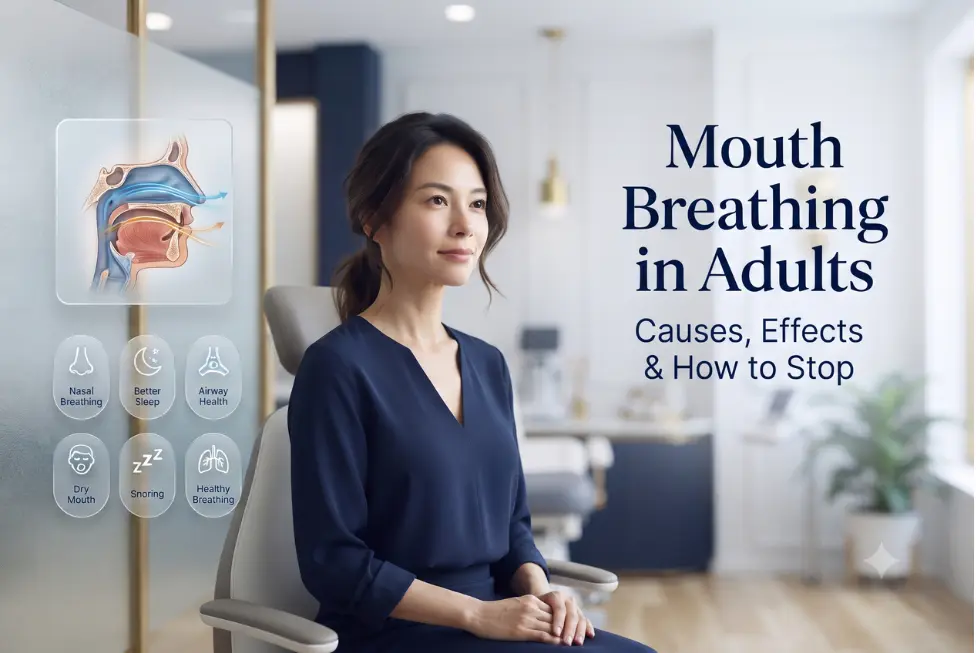
We tend to think of mouth breathing as a childhood issue. But it’s just as common – and just as harmful – in adults. If you wake with a dry mouth, snore, feel tired despite enough sleep, or simply notice your lips are usually parted, you may be a chronic mouth breather without realising it. In fact, once you pass the age of 40, you are around 60% more likely to spend at least half the night breathing through an open mouth. The good news is that nose breathing can be relearned – and doing so improves your sleep, your teeth, your posture and your overall health.
Quick answer: Mouth breathing in adults is usually caused by a blocked nose (allergies, a deviated septum, congestion), excess weight, back-sleeping, alcohol before bed, or simple habit. Over time it dries the mouth (causing cavities, gum disease and bad breath), worsens snoring and sleep apnea, triggers morning headaches, and encourages forward-head posture. You can fix it by clearing the nose, retraining nasal breathing, side-sleeping, and treating any underlying airway problem.
| Key takeaways
✓ Mouth breathing isn’t just a childhood problem – it’s common and harmful in adults too. ✓ Usual causes: a blocked nose, excess weight, back-sleeping, alcohol, and habit. ✓ Effects: dry mouth, cavities, gum disease, bad breath, snoring, poor sleep, headaches and neck/posture strain. ✓ It often goes hand-in-hand with snoring and sleep apnea. ✓ Nose breathing can be retrained – clear the nose, fix the cause, and re-educate your breathing. |
Are You a Mouth Breather? Common Signs
Many adults mouth-breathe at night without ever knowing. Look for a cluster of these signs:
| Signs of chronic mouth breathing
✓ Waking with a very dry mouth, or drool on the pillow ✓ Persistent bad breath (‘morning breath’ that lingers) ✓ Snoring, and waking unrefreshed despite enough hours ✓ Lips that rest apart; you ‘catch’ yourself breathing through your mouth ✓ Frequent nasal congestion, allergies, or a blocked nose ✓ Morning headaches and a dry, sore throat on waking |
Why Nose Breathing Matters (Nose vs Mouth)
We’re designed to breathe through the nose, not the mouth. The nose isn’t just an airway – it conditions every breath. Here’s the difference.
| Nose breathing | Mouth breathing | |
| Filters & humidifies air | Yes – filters dust, warms & moistens | No – dry, unfiltered air |
| Airway support | Supports a stable airway & jaw posture | Lets the tongue & jaw fall back |
| Sleep quality | Calmer, deeper sleep | Fragmented; more snoring |
| Mouth & teeth | Keeps saliva protective | Dries the mouth – cavities, gum disease |
| Effect over time | Healthier breathing & posture | Strain, fatigue, dental & sleep problems |
Why Do Adults Mouth-Breathe?
It almost always comes back to one thing: nose breathing has become difficult, so the body switches to the mouth. The common reasons:
- A blocked nose: Allergies, chronic congestion, a deviated septum, or nasal polyps make nasal breathing hard.
- Excess weight: Extra tissue around the neck and tongue narrows the airway, especially lying down.
- Sleeping on your back: Gravity lets the jaw and tongue fall back, opening the mouth.
- Alcohol and late meals: Both relax the airway muscles and worsen night-time mouth breathing.
- Sometimes the original blockage clears but the open-mouth pattern remains and needs retraining.
The Effects of Mouth Breathing on Your Health
Your sleep
Mouth breathing dries the airway and lets the tongue fall back, which worsens snoring and fragments your sleep. It’s strongly linked to sleep-disordered breathing, including obstructive sleep apnea – so you wake unrefreshed even after a full night, and your heart works harder overnight.
Your teeth and gums
Breathing through your mouth dries it out, removing the protective effect of saliva. The result is a higher risk of cavities and gum disease, plus persistent bad breath – which is why mouth breathers often have dental problems despite good brushing.
Your posture, neck and jaw
To keep the mouth-airway open, the lower jaw drops and the head tilts forward. Over time this ‘forward-head posture’ creates tension in the neck, shoulders and back – and changes how the jaw rests, which can feed TMJ problems.
Your energy and focus
Poor-quality, fragmented sleep means daytime tiredness, low energy, and trouble concentrating. Many people put this down to stress or age, when the real issue is how they breathe at night.
How to Stop Mouth Breathing
The goal is to make nose breathing easy again, then retrain the habit. A practical plan:
- Clear your nose. Treat allergies and congestion – saline rinses, and where needed, a doctor’s advice on a deviated septum or chronic blockage. This is the single most effective first step.
- Try a nasal dilator or strip. These widen the nostrils and make nasal breathing easier, especially at night.
- Sleep on your side. It keeps the jaw and tongue forward and the mouth closed; raise the head of the bed too.
- Re-train your breathing. Gentle nasal and diaphragmatic breathing exercises during the day rebuild the habit of breathing through your nose.
- Address weight, alcohol and late meals. All three worsen night-time mouth breathing.
- Treat the underlying airway. If a narrow airway or jaw position is the cause, an airway-focused assessment finds and fixes it.
A note on mouth taping: taping the lips at night is popular online, but it should only be done after a professional has confirmed your nose is clear and there’s no underlying sleep apnea – never as a first step.
When Mouth Breathing Signals Something More
Chronic mouth breathing is often a red flag for sleep-disordered breathing. If yours comes with loud snoring, gasping, or daytime exhaustion, it’s worth being assessed for obstructive sleep apnea – which is very treatable.
Read more about how the jaw and airway affect your sleep,
And if your child mouth-breathes, the stakes are different – see our guide to mouth breathing in children.
Why Choose Airway TMJ & Sleep Center in Noida
Mouth breathing sits at the crossroads of the nose, the jaw, the airway and your sleep – which is exactly our focus. At Airway TMJ & Sleep Center in Noida, Dr. Kishlay Gaur (FICCMO) takes an airway-centred approach: assessing how your jaw, bite and airway work together, finding why nasal breathing has become difficult, and treating the cause – from a custom oral appliance to coordinated care for the nose and airway. The aim is simple: help you breathe through your nose, sleep deeply, and feel the difference.
The Bottom Line
Mouth breathing in adults is common, easy to overlook, and quietly damaging – affecting your sleep, your teeth, your posture and your energy. The encouraging news is that it’s fixable: clear the nose, retrain nasal breathing, sleep on your side, and treat any underlying airway problem. And because mouth breathing so often travels with snoring and sleep apnea, if those sound familiar, getting assessed is the smartest next step toward better breathing and better sleep.
Book an airway and breathing assessment in Noida to find out why you mouth-breathe – and the simplest way to fix it.