
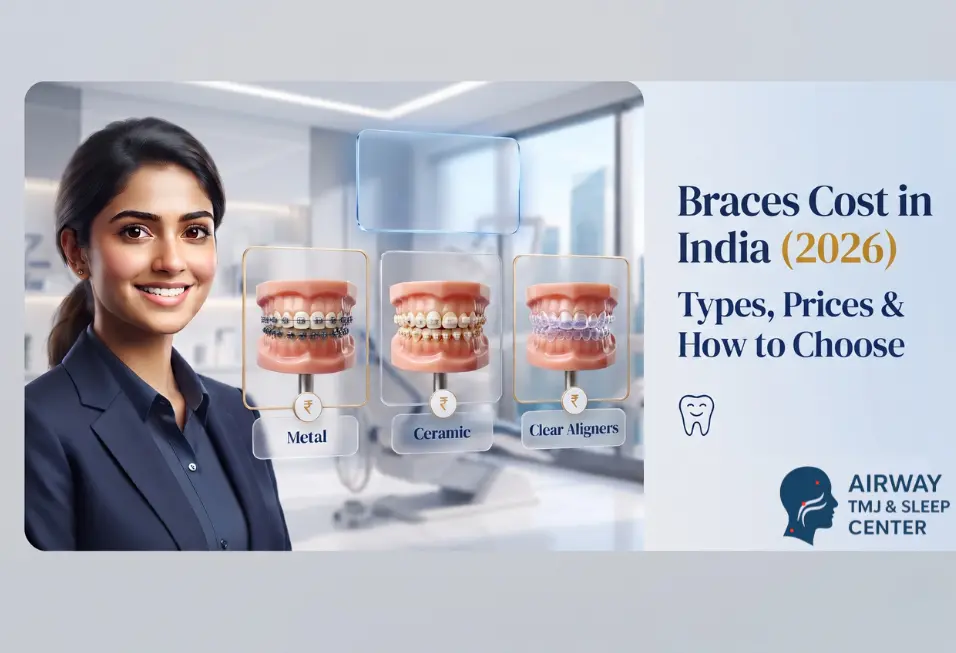
Braces Cost in India (2026): Types, Prices and How to Choose
Thinking about straightening your teeth and wondering about the real braces cost in India? In 2026, dental braces typically cost anywhere from about ₹25,000 for standard metal braces to ₹2,50,000 or more for hidden lingual braces. The right choice — and the right price — depends on the type of braces, how complex your case is, and the expertise behind the treatment. This guide breaks it all down clearly.
At Airway TMJ & Sleep Center in Noida, we plan orthodontic treatment through a bite-aware, neuromuscular lens — because well-aligned teeth should also bite and function correctly, not just look straight. So along with the prices, we explain why how your braces are planned matters as much as which type you choose.
How much do braces cost in India in 2026?
In 2026, braces cost in India broadly ranges from ₹25,000 to ₹2,50,000 depending on type: metal braces ₹25,000–₹60,000, ceramic ₹40,000–₹1,20,000, self-ligating ₹50,000–₹1,50,000, and lingual (hidden) braces ₹1,00,000–₹2,50,000 or more. Your case complexity sets the final price.
Because every smile is different, prices vary with how much correction is needed and where you are treated. The table below shows the typical 2026 ranges in India by braces type.
| Type of braces | Typical cost (India, 2026) | Key feature |
| Metal braces | ₹25,000 – ₹60,000 | Most affordable, very effective |
| Ceramic braces | ₹40,000 – ₹1,20,000 | Tooth-coloured, less visible |
| Self-ligating braces | ₹50,000 – ₹1,50,000 | No elastic ties, fewer visits |
| Lingual braces | ₹1,00,000 – ₹2,50,000+ | Fixed behind teeth, invisible from front |
Many clinics offer EMI options, sometimes from around ₹3,000 per month. Always confirm whether the quote includes consultations, X-rays/scans, adjustments, and retainers after treatment.
What are the different types of braces?
The main types are metal braces (the classic, most affordable option), ceramic braces (tooth-coloured and discreet), self-ligating braces (no elastic ties, lower maintenance), and lingual braces (fixed behind the teeth, invisible from the front). Clear aligners are a removable alternative.
- Metal braces — durable stainless-steel brackets and wires; the most economical and effective for most cases.
- Ceramic braces — tooth-coloured brackets that blend in; aesthetic but pricier and slightly more delicate.
- Self-ligating braces — use a built-in clip instead of elastic ties, often meaning fewer adjustment visits.
- Lingual braces — bonded to the inside of the teeth so they are hidden; the most discreet fixed option and the most expensive.
- Clear aligners — removable, near-invisible trays; a popular alternative covered in our aligners guides.
What affects the cost of braces?
Braces cost depends on the type you choose, how complex your misalignment is, how long treatment takes, the orthodontist’s experience, your city, and add-ons such as scans, extractions and retainers. Hidden or aesthetic options cost more than standard metal braces.
- Type of braces — metal is cheapest; lingual and aesthetic options cost more.
- Case complexity — minor crowding is far cheaper than correcting a severe bite.
- Treatment duration — longer cases need more adjustment visits.
- Orthodontist’s expertise and your location (metro clinics often cost more).
- Add-ons — diagnostics, extractions if needed, and retainers after treatment.
Braces vs clear aligners — which should you choose?
Braces are fixed, work for almost any case (including complex ones) and are often more economical. Clear aligners are removable, near-invisible and convenient for mild-to-moderate cases. The best choice depends on your case complexity, budget and lifestyle — and on getting the bite right either way.
Both straighten teeth effectively. Fixed braces handle the widest range of problems, including complex bites, and tend to be more budget-friendly. Clear aligners suit many mild-to-moderate cases and appeal to adults who want a discreet, removable option. Rather than ‘one is better,’ the right answer depends on your specific bite, how disciplined you can be with removable trays, and your budget.
How long does braces treatment take?
Most braces treatment takes about 12 to 24 months, though simple cases can finish sooner and complex bites take longer. Treatment time depends on the problem being corrected, the braces type and how well you keep appointments and care for your teeth.
There is no fixed timeline, but a common range is one to two years. Minor corrections can be quicker, while significant bite problems take longer. Wearing retainers afterwards is essential to keep your new smile in place — skipping them is the most common reason teeth drift back.
Does a good bite matter as much as straight teeth?
Yes — arguably more. Teeth that look straight but bite unevenly can strain the jaw muscles and joints, contributing to clenching, jaw fatigue or TMJ symptoms. A bite-aware (neuromuscular) orthodontic plan aligns your teeth and your bite, so the result is comfortable and stable.
It is easy to focus only on appearance, but orthodontics changes how your jaw closes. If the bite is not planned carefully, a cosmetically straight result can still overload the jaw and lead to problems later. As part of our neuromuscular orthodontics service, we plan around how your teeth, jaw joints and muscles work together — protecting your jaw and helping the result last.
What happens if you delay treating a misaligned bite?
Delaying can allow crowding and bite problems to worsen, making teeth harder to clean (raising decay and gum-disease risk) and adding strain to the jaw. An uneven bite can contribute to wear, clenching and jaw pain over time, so earlier correction is usually simpler and protects long-term oral health.
Crooked teeth and an uneven bite are not just cosmetic. Misaligned teeth are harder to clean, which raises the risk of cavities and gum disease, and a poor bite can accelerate tooth wear and load the jaw unevenly. Treating it earlier is generally faster, easier and better for your long-term oral and jaw health.
Book an Orthodontic & Bite Consultation in Noida
Want a clear quote and a plan that straightens your teeth and gets your bite right? Airway TMJ & Sleep Center offers bite-aware, neuromuscular orthodontic care — braces and aligners — for a comfortable, lasting result. Serving Noida and Delhi NCR.
📍 C-98/10, C Block Market, Sector 41, Noida 201301 | 📞 +91 87566 15325 | 🌐 airwaytmjsleep.com
Disclaimer: This article is for general education only and is not a substitute for professional dental advice. Costs and timelines vary; please seek an in-person consultation for a personalised quote and plan.