
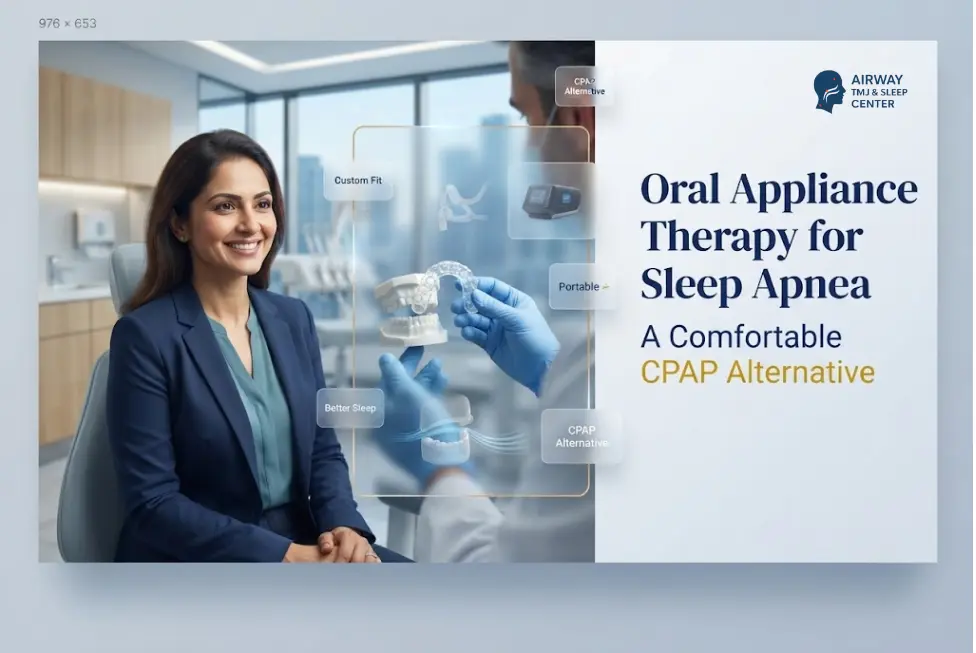
Oral Appliance Therapy for Sleep Apnea: A Comfortable CPAP Alternative
If you have been diagnosed with sleep apnea but cannot tolerate a CPAP machine — or you snore heavily and want a simpler fix — oral appliance therapy may be the answer. It uses a small, custom-made device, worn only in the mouth during sleep, to keep your airway open. For many people with mild-to-moderate obstructive sleep apnea, it is a comfortable, travel-friendly and highly effective alternative to CPAP.
As a dental sleep medicine service, oral appliance therapy sits right at the intersection of dentistry and sleep — which is exactly what an airway-focused clinic does best. This guide explains how it works, how it compares with CPAP, who it suits, and what to expect.
🔑 Key Takeaways
- Oral appliance therapy uses a custom device that gently holds the lower jaw forward to keep the airway open during sleep.
- It is a leading, evidence-backed first-line option for mild-to-moderate obstructive sleep apnea and for snoring.
- Compared with CPAP, it reduces apnea a little less on paper but people wear it far more, so real-world results are often comparable.
- It is comfortable, silent, portable and easy to travel with.
- It must be custom-fitted and monitored — a TMJ- and bite-aware clinic is ideal, because the jaw and bite need watching.
What is oral appliance therapy?
Oral appliance therapy is a treatment for snoring and obstructive sleep apnea that uses a custom-made dental device worn during sleep. It holds the lower jaw slightly forward to keep the airway open, preventing the soft tissues at the back of the throat from collapsing and blocking your breathing.
An oral appliance looks a little like a sports mouthguard or a set of clear aligners, but it is engineered to reposition the jaw. Because it is small, silent and needs no power or hose, many people find it far easier to live with than a CPAP machine. It is fitted and adjusted by a dentist trained in dental sleep medicine, working alongside your sleep physician.
How does a mandibular advancement device work?
A mandibular advancement device (the most common oral appliance) fits over your upper and lower teeth and gently advances the lower jaw. This pulls the tongue and soft tissues forward, enlarging and stabilising the airway so it stays open — reducing the breathing pauses of sleep apnea and the vibration that causes snoring.
During sleep, the muscles that hold your airway open relax. In obstructive sleep apnea, the airway narrows or collapses, causing repeated pauses in breathing. By holding the lower jaw slightly forward, a mandibular advancement device keeps the space behind the tongue open, so air can flow freely. Good devices are adjustable, letting your dentist fine-tune the jaw position for the best balance of comfort and results.
Is oral appliance therapy as effective as CPAP?
For mild-to-moderate sleep apnea, yes — in practice. CPAP lowers the apnea score more on paper, but many people struggle to wear it. Because oral appliances are much easier to tolerate (over 90% nightly use), the real-world health benefit is often comparable, with similar improvements in symptoms and quality of life.
This is the key insight of modern dental sleep medicine: the best treatment is the one you actually use. Oral appliances have success rates around 70% for mild-to-moderate cases and very high nightly compliance, while CPAP is more powerful but frequently abandoned. Because a device worn all night beats a machine left in the drawer, oral appliance therapy often delivers equivalent everyday results — and it can also help selected severe cases when CPAP is not tolerated.
Oral appliance vs CPAP — which should you choose?
CPAP is the most powerful treatment and first choice for severe sleep apnea. An oral appliance is preferred for mild-to-moderate apnea, for snoring, and for anyone who cannot tolerate CPAP. Many people choose the appliance for comfort, quietness and travel — the right choice depends on your severity and lifestyle.
| Factor | Oral appliance | CPAP machine |
| Best for | Mild–moderate OSA, snoring, CPAP-intolerant | Moderate–severe OSA |
| Comfort & use | Small, silent, no hose; high nightly use | Effective but harder to tolerate |
| Travel | Pocket-sized, no power needed | Bulky, needs power |
| Effect on apnea | Strong for mild–moderate | Strongest overall |
| Main trade-off | Not ideal for very severe cases | Lower long-term adherence |
Who is a good candidate for an oral appliance?
Good candidates have mild-to-moderate obstructive sleep apnea or heavy snoring, enough healthy teeth to hold the device, healthy gums, and no active jaw-joint (TMJ) problem. People who can’t tolerate CPAP are ideal candidates. A dental and sleep assessment confirms suitability.
- Mild-to-moderate obstructive sleep apnea, or troublesome snoring.
- Difficulty tolerating or sticking with CPAP.
- Enough healthy natural teeth to support the device, with healthy gums.
- No active temporomandibular joint (TMJ) dysfunction — this is assessed first.
- Selected severe cases where CPAP is refused or not tolerated, in coordination with a sleep physician.
Does an oral appliance help snoring too?
Yes. Snoring is caused by soft tissues vibrating as air squeezes past a narrowed airway. By holding the jaw forward and opening that airway, an oral appliance reduces or stops the vibration — making it an effective, comfortable solution for simple snoring as well as sleep apnea.
Many people first seek help because of snoring — often at a partner’s request. A custom oral appliance is one of the most effective ways to quieten snoring, and because heavy snoring can be a sign of underlying sleep apnea, having it assessed properly means you treat the cause, not just the noise.
Are there any side effects?
Side effects are usually mild and manageable: temporary jaw or tooth tenderness, extra saliva or dry mouth in the morning, and, over long-term use, small changes to the bite. Regular reviews with a dentist catch and manage these early, which is why professional fitting and monitoring matter.
Most people adjust to an oral appliance within a week or two. Early on you may notice mild jaw or tooth soreness or changes in saliva, which typically settle. With long-term use, the bite can shift very slightly, so periodic check-ups and simple morning exercises are used to keep everything stable. This is exactly why an appliance should be custom-made and monitored — not bought off the shelf.
Why the clinic matters: Because an oral appliance moves the jaw, the TMJ and bite must be checked before and during treatment. A clinic that specialises in TMJ and airway is ideally placed to fit an appliance safely and keep your jaw healthy.
What happens if sleep apnea goes untreated?
Untreated sleep apnea strains the body night after night, raising the risk of high blood pressure, heart disease, stroke, type 2 diabetes, daytime fatigue and accidents, while worsening mood and concentration. Treating it — with an oral appliance or CPAP — protects long-term health and transforms daily energy.
The repeated drops in oxygen and fragmented sleep of untreated apnea take a real toll over time, and the daytime sleepiness raises accident risk today. The encouraging news is that effective treatment is available and, with an oral appliance, often easy to stick with — so the barrier to protecting your health is lower than many people fear.
Book an Oral Appliance & Airway Consultation in Noida
Can’t tolerate CPAP, or snoring keeping the household awake? Airway TMJ & Sleep Center fits custom oral appliances and monitors your bite and jaw as part of a complete airway approach, in coordination with your sleep physician. Serving Noida and Delhi NCR.
📍 C-98/10, C Block Market, Sector 41, Noida 201301 | 📞 +91 87566 15325 | 🌐 airwaytmjsleep.com
Disclaimer: This article is for general education only and is not a substitute for professional medical or dental advice. Sleep apnea is diagnosed via a sleep study interpreted by a physician; individual results vary. Please seek an in-person evaluation.