
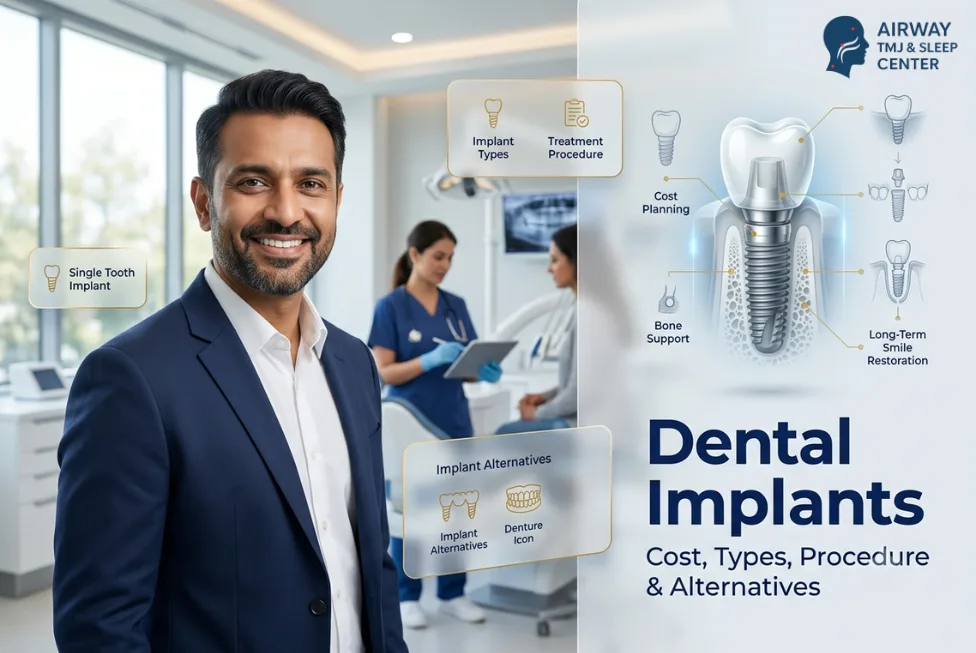
Losing a tooth affects far more than your smile. It changes how you chew, how your bite meets, and over time even how your jawbone holds its shape. Dental implants are widely regarded as the gold standard for replacing missing teeth – the closest thing to a natural tooth, both in look and function. This guide explains what implants are, the types available, exactly how the procedure works, what they cost in India and Noida, and how they compare with bridges and dentures – plus one thing most implant clinics overlook: planning implants around your bite and jaw.
A dental implant is a small titanium (or zirconia) post placed in the jawbone to replace a missing tooth root, topped with a crown that looks and works like a natural tooth. In India, a single implant typically costs Rs 35,000-65,000 and full-mouth implants Rs 3-8 lakh. Implants have a 95-98% success rate, can last 20 years or more, and are the only option that prevents the bone loss that follows a missing tooth.
| Key takeaways
✓ A dental implant replaces the tooth root with a titanium post, then a crown on top – the most natural, durable option. ✓ Implants prevent jawbone loss; bridges and dentures do not. ✓ Success rate is 95-98% and a well-cared-for implant can last 20-30+ years. ✓ In India: roughly Rs 35,000-65,000 per single implant; Rs 3-8 lakh for full-mouth. ✓ For lasting results, implants should be planned around your bite and jaw – not just the gap (functional implantology). |
What Is a Dental Implant?
A dental implant is an artificial tooth root – a small, biocompatible post (usually titanium, sometimes zirconia) that is placed into the jawbone where a tooth is missing. Over a few months it fuses with the bone in a natural process called osseointegration, creating a strong, permanent foundation. A connector (abutment) is then fitted, and finally a custom crown, bridge or full-arch prosthesis is attached on top. The result looks, feels and functions like a natural tooth.
An implant has three parts:
- The implant post – the titanium/zirconia ‘root’ placed in the jawbone.
- The abutment – the connector that links the post to the crown.
- The crown – the visible, custom-made tooth, matched to your natural teeth.
Why Replacing a Missing Tooth Matters
It’s tempting to ignore a single missing tooth, especially at the back where it doesn’t show. But a gap rarely stays a simple gap:
- Bone loss. Without a tooth root to stimulate it, the jawbone in that area begins to shrink – denture wearers can lose up to 0.5 mm of bone height per year.
- Teeth shift. Neighbouring teeth drift into the gap and the opposing tooth can over-erupt, throwing off your bite.
- Bite and jaw strain. An uneven bite makes you chew on one side and can overload the jaw joints – a contributor to TMJ problems.
- Function and confidence. Chewing becomes harder, speech can change, and many people hide their smile.
Because a missing tooth can unbalance the bite and strain the jaw, replacing it properly also protects against problems we treat every day – see our guide to TMJ disorders.
Types of Dental Implants
There isn’t one type of implant – the right choice depends on your bone, the number of missing teeth, and your goals. The main options:
| Type | Best for | Notes |
| Endosteal (in the bone) | Most patients with healthy jawbone | The standard, most common implant |
| Subperiosteal (on the bone) | Patients with limited bone height | Sits under the gum, on top of the bone |
| All-on-4 / All-on-6 | A full arch of missing teeth | A fixed full set on just 4-6 implants |
| Zygomatic | Severe upper-jaw bone loss | Anchored in the cheekbone; specialist procedure |
| Mini implants | Small spaces; stabilising dentures | Smaller, lower-cost, less invasive |
| Immediate-load (‘same-day’) | Selected suitable cases | Temporary tooth placed the same day |
Dental Implants vs Bridges vs Dentures
If you’re weighing your options, this is the comparison that matters most. Implants cost more upfront but win on longevity, function and bone protection.
| Feature | Dental implant | Dental bridge | Dentures |
| Lifespan | 20-30+ years (often lifetime) | 5-15 years | Re-fit/replace every few years |
| Success / durability | 95-98% over 10 years | Good, but shorter | Lowest; loosens over time |
| Prevents bone loss | Yes | No | No (can speed it up) |
| Affects nearby teeth | No | Grinds down neighbours | No |
| Chewing power | 80-90% of natural | Good | Reduced; avoid hard foods |
| Upfront cost | Highest | Moderate | Lowest |
| Feels natural | Most natural | Fixed, fairly natural | Removable, least natural |
In short: a bridge or denture can be the right call in some cases, but an implant is the only option that replaces the root, protects the bone, and leaves your other teeth untouched – which is why it usually offers the best long-term value.
Dental Implant Cost in India and Noida
India is one of the most cost-effective places in the world for high-quality implants. Cost depends on the number of implants, the implant brand, the crown material, and whether you need extra procedures. Treat the ranges below as indicative for planning – your exact cost comes after an examination and a CBCT scan.
| Treatment | Approximate cost in India (INR) |
| Single tooth implant | Rs 35,000 – 65,000 (implant + abutment + crown) |
| Multiple implants | Scales with the number of implants |
| All-on-4 (one full arch) | Often around Rs 1.5 – 4 lakh per arch |
| Full-mouth implants | Rs 3 – 8 lakh, depending on complexity |
| Add-ons (may be extra) | Bone graft, sinus lift, CBCT scan, temporary teeth |
What’s usually included: the implant, abutment and crown. Extras such as bone grafting, a sinus lift, CBCT imaging or temporary teeth are often quoted separately – so always ask for an itemised, all-inclusive estimate.
The Dental Implant Procedure, Step by Step
Implant treatment is staged over a few months, with most of that time being healing – the active appointments are short. A typical journey:
- Consultation & 3D scan. A full assessment with a CBCT scan to check bone, nerves and your bite, and to plan the implant position precisely.
- Preparation (if needed). Any extraction, bone graft or sinus lift to build a solid foundation.
- Implant placement. The titanium post is placed into the jawbone – usually a comfortable, minor procedure under local anaesthetic.
- Healing (osseointegration). Over roughly 3-6 months, the implant fuses with the bone. A temporary tooth can often be worn in the meantime.
- Abutment & crown. Once fused, the abutment is fitted and your custom crown is attached – and you bite, chew and smile normally again.
Some suitable cases qualify for immediate-load or ‘same-day’ implants, where a temporary tooth is placed on the day of surgery. Your specialist will tell you if you’re a candidate.
Are You a Candidate for Dental Implants?
Most adults with one or more missing teeth are suitable. Implants are typically a good option if you:
- Have one, several, or all teeth missing and want a permanent, natural-feeling solution.
- Have healthy gums and enough jawbone (or are willing to have a graft to build it).
- Are in reasonable general health and don’t smoke heavily (smoking lowers success).
- Want to avoid grinding down healthy teeth (as a bridge requires) or wearing removable dentures.
Conditions like uncontrolled diabetes or gum disease are addressed first – a proper assessment confirms your suitability and the best plan.
Functional Implantology: Why the Bite Matters
This is where a TMJ and neuromuscular practice does implants differently. Most clinics replace the tooth and match the crown to the gap. Functional implantology goes further: it plans the implant and crown around how your whole bite and jaw work together. Why it matters:
- A crown that sits even slightly ‘high’ or off can overload the implant and strain the jaw joint.
- Replacing teeth in the right position restores even chewing and protects the TMJ.
- In patients who clench or grind, an unprotected implant crown can be damaged – so the bite and any bruxism are managed too.
This bite-aware philosophy is the same one behind our neuromuscular orthodontics, and if you grind your teeth, a
Caring for Your Implants (and Making Them Last)
- Brush twice daily and floss around the implant – care for it like a natural tooth.
- Keep regular check-ups and professional cleanings.
- Protect against grinding with a night guard if you clench at night.
- Avoid smoking, which significantly lowers implant success.
- Report any looseness, pain or gum swelling early.
Why Choose Airway TMJ & Sleep Center in Noida
At Airway TMJ & Sleep Center in Noida, dental implants are part of our functional implantology approach – we don’t just fill the gap, we rebuild your bite the right way. Led by Dr. Kishlay Gaur (FICCMO Fellow), we plan every implant with the jaw joints, muscles and bite in mind, using detailed diagnostics including CBCT imaging. The result is a tooth replacement that looks natural, chews well, and protects your jaw and remaining teeth for years. For single implants, full-mouth restoration, or rebuilding a worn bite, our root-cause approach gives durable, comfortable results.
The Bottom Line
Dental implants are the most natural, durable and bone-protective way to replace missing teeth – with a 95-98% success rate and a lifespan measured in decades. In India they’re excellent value, with single implants typically Rs 35,000-65,000. The smartest approach is to choose a provider who plans your implant around your bite and jaw, not just the gap, so the result lasts and protects your whole mouth. If you’re missing one or more teeth, a consultation and 3D scan are the best first step.
Book a dental implant consultation in Noida to get a personalised plan and an itemised estimate.