
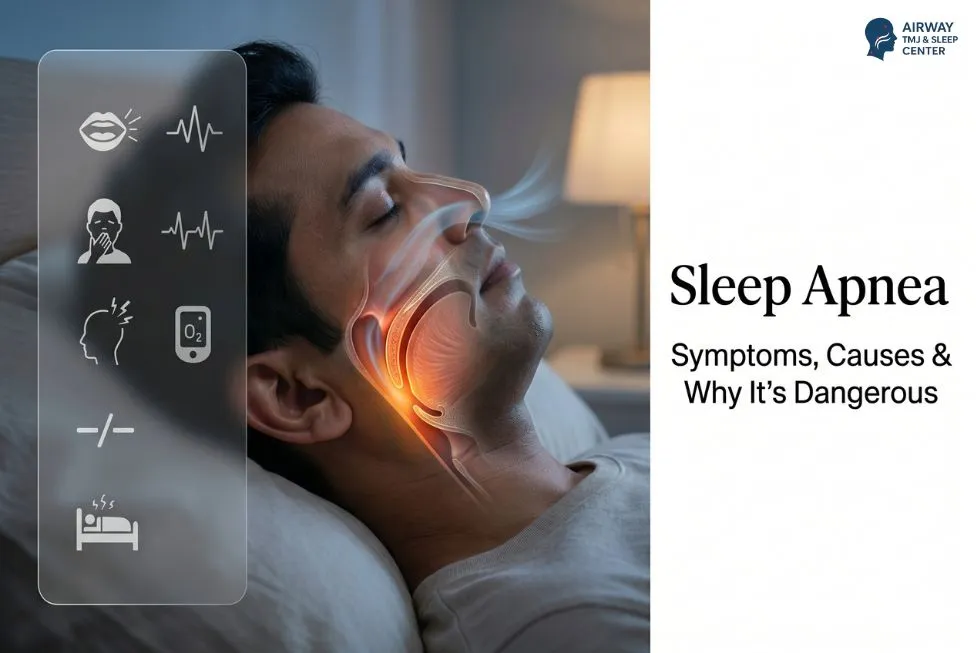
Sleep Apnea: Symptoms, Causes, and Why It’s Dangerous
Sleep apnea is one of the most common – and most under-diagnosed – sleep disorders. Many people live with it for years, blaming their exhaustion on a busy life, while their breathing quietly stops and starts dozens of times a night. It’s more than loud snoring or poor sleep: untreated, sleep apnea puts real strain on the heart and overall health. The encouraging news is that it’s very treatable once it’s recognised.
This guide explains what sleep apnea is, the night-time and daytime symptoms to watch for, what causes it, who’s most at risk, the genuine dangers of leaving it untreated, and how it’s diagnosed and treated – including comfortable alternatives to the CPAP mask.
Quick answer: Sleep apnea is a disorder where your breathing repeatedly stops and starts during sleep because the airway collapses or the brain briefly stops signalling you to breathe. The main signs are loud snoring, gasping or choking at night, and heavy daytime sleepiness. It’s caused by airway blockage (often the tongue and soft tissue falling back), and risk rises with weight, age, and certain jaw and airway shapes. Untreated, it raises the risk of heart disease, stroke, and diabetes – but treatment, from CPAP to oral appliances, greatly reduces that risk.
| Key takeaways
✓ Sleep apnea means breathing repeatedly stops and starts during sleep, lowering your oxygen. ✓ Watch for loud snoring, gasping or pauses in breathing, and severe daytime tiredness. ✓ The most common type (obstructive) happens when the tongue and throat tissues block the airway. ✓ Untreated, it’s linked to high blood pressure, heart attack, stroke, and diabetes. ✓ It’s very treatable – with CPAP, a custom oral appliance, or lifestyle changes – so getting diagnosed matters. |
What Is Sleep Apnea?
Sleep apnea is a condition in which your breathing is repeatedly interrupted while you sleep. Each pause – called an apnea – can last seconds to longer, and may happen dozens or even hundreds of times a night. Every time it happens, your oxygen drops and your brain briefly rouses you to restart breathing, fragmenting your sleep so badly that you never reach the deep, restorative stages. You usually don’t remember any of it – you just wake up exhausted.
There are three types:
| Type | What happens |
| Obstructive sleep apnea (OSA) | The most common type – the throat muscles relax and the tongue and soft tissue block the airway |
| Central sleep apnea (CSA) | The brain doesn’t send the right signals to the muscles that control breathing |
| Mixed / complex | A combination of both obstructive and central apnea |
Symptoms of Sleep Apnea
Sleep apnea shows up both at night and during the day – and because the night-time signs happen while you’re asleep, they’re often noticed first by a partner.
| Night-time signs (often noticed by a partner)
✓ Loud, chronic snoring ✓ Gasping, choking, or snorting awake ✓ Witnessed pauses in breathing ✓ Restless sleep and frequent waking ✓ Waking to urinate, dry mouth, or a sore throat |
| Daytime signs
✓ Excessive daytime sleepiness or falling asleep easily ✓ Waking unrefreshed, with morning headaches ✓ Trouble concentrating, memory lapses, and irritability ✓ Low mood or low energy, and reduced libido ✓ A scalloped or indented tongue – a possible clue to airway crowding |
What Causes Sleep Apnea?
In obstructive sleep apnea – by far the most common form – the cause is a blocked airway. When you fall asleep and the muscles relax, the tongue and soft tissues at the back of the throat can collapse inward, narrowing or closing the airway. The position and size of your jaw, tongue, and airway play a big role, which is why two people with the same weight can have very different risk. In central sleep apnea, the issue isn’t a blockage but the brain’s breathing signals.
Who’s at Risk? Risk Factors
Some risk factors you can’t change, and others you can. Knowing them helps you judge your own risk – and act on the parts within your control.
| You can’t change | You can influence |
| Age (risk rises as you get older) | Excess weight (a major, modifiable factor) |
| Being male (higher risk, especially early adulthood) | Alcohol and sedatives near bedtime |
| Family history and genetics | Smoking |
| Jaw, skull, and airway shape (narrow airway, set-back jaw) | Nasal congestion and allergies |
| Certain conditions (e.g. hypothyroidism, PCOS) | Sleeping on your back |
Can Sleep Apnea Kill You? The Real Dangers
It’s a question many people search – and the honest answer is that while you’re very unlikely to die from a single apnea episode, untreated sleep apnea is genuinely dangerous over time. People with untreated moderate-to-severe sleep apnea are several times more likely to die from any cause than those without it. The reason is the nightly strain on the body: every time your oxygen drops, your heart rate and blood pressure spike, and over months and years that takes a toll.
Untreated sleep apnea is linked to:
- High blood pressure that’s hard to control
- Heart attack, heart failure, and dangerous heart rhythms
- Stroke and an increased risk of sudden cardiac events
- Type 2 diabetes and weight gain
- Depression, poor concentration, and a higher risk of accidents from daytime sleepiness
The reassuring flip side: effective treatment substantially reduces these risks. That’s exactly why recognising and treating sleep apnea early is so worthwhile – it’s not just about sleeping better, it’s about protecting your heart and your life.
How Is Sleep Apnea Diagnosed?
Sleep apnea can only be confirmed by a medical assessment, usually including a sleep study (done in a lab or, increasingly, at home) that measures your breathing, oxygen levels, and sleep through the night. If you recognise the symptoms – especially loud snoring with gasping and daytime exhaustion – the first step is to get evaluated rather than guess.
How Is Sleep Apnea Treated?
Treatment is tailored to severity, but most people have effective options:
- A machine that delivers gentle air pressure to keep the airway open – very effective, and the standard for moderate-to-severe cases.
- Custom oral appliance. A comfortable, mouth-worn device that holds the lower jaw slightly forward to keep the airway open – ideal for snoring and mild-to-moderate apnea, and for people who can’t tolerate CPAP.
- Lifestyle changes. Weight management, side-sleeping, limiting evening alcohol, and treating nasal congestion all help.
- Treating the airway. Addressing nasal blockage, enlarged tonsils, or jaw position can be part of the plan.
For many people, an oral appliance is a genuine, easier-to-use alternative to the CPAP mask – read more about oral appliances and CPAP alternatives.
| See a doctor promptly if you have
✓ Loud snoring with gasping, choking, or witnessed pauses in breathing ✓ Severe daytime sleepiness, or falling asleep while driving or working ✓ Morning headaches and waking unrefreshed despite enough hours in bed ✓ High blood pressure that’s difficult to control ✓ A partner who has noticed you stop breathing in your sleep |
Why Choose Airway TMJ & Sleep Center in Noida
Sleep apnea sits at the intersection of the airway, the jaw, and breathing – which is precisely the focus at Airway TMJ & Sleep Center in Noida. Dr. Kishlay Gaur takes an airway-centred approach, assessing how your jaw and airway work together and offering custom oral appliance therapy as a comfortable, effective option for snoring and mild-to-moderate sleep apnea – coordinating wider care where a sleep study or other treatment is needed. The goal is simple: protect your health and give you the deep, restful sleep your body needs.
The Bottom Line
Sleep apnea is far more than snoring – it’s repeated pauses in breathing that rob you of restorative sleep and, over time, strain your heart and health. The signs are recognisable: loud snoring, gasping at night, and relentless daytime tiredness. If that sounds like you or someone you love, don’t wait it out. Sleep apnea is very treatable, and getting diagnosed is the first step to better sleep and a healthier heart.
Book a sleep and airway assessment in Noida to find out whether sleep apnea is behind your symptoms – and the most comfortable way to treat it.