
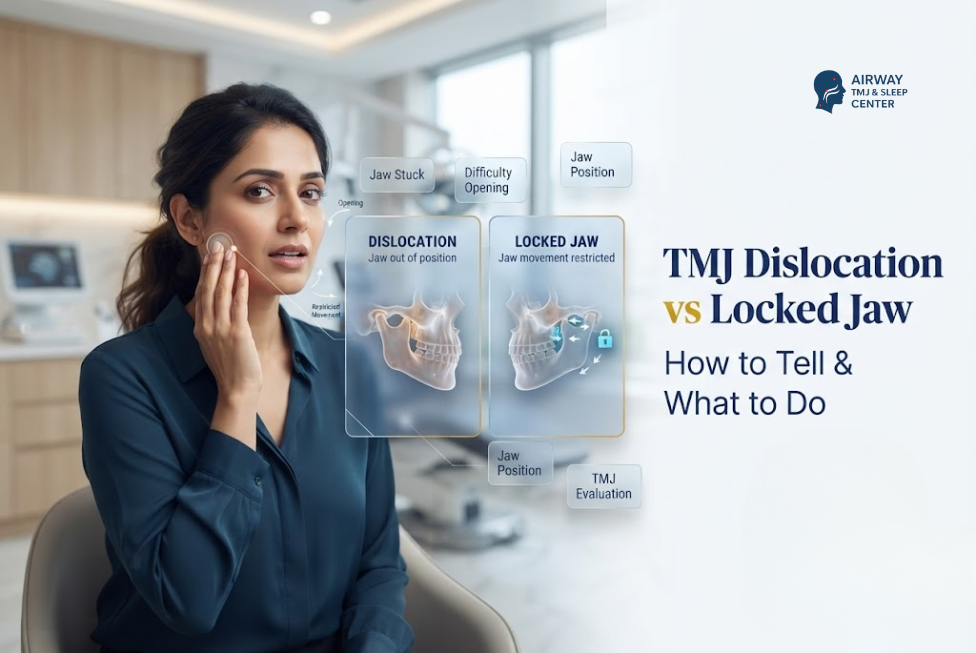
TMJ Dislocation vs Locked Jaw: How to Tell and What to Do
A jaw stuck open that cannot close may be a TMJ dislocation and needs urgent medical attention. Do not try to push it back. A jaw that can close but will not open fully may be a ‘closed lock’ or another condition and needs prompt clinical assessment. If you cannot tell which is happening, choose urgent care.
A jaw stuck open that cannot close may be a TMJ dislocation and needs urgent medical attention. Do not try to push it back. A jaw that can close but will not open fully may be a ‘closed lock’ or another condition and needs prompt clinical assessment. If you cannot tell which is happening, choose urgent care.
Jaw dislocation vs locked jaw at a glance
| Clue | Suspected TMJ dislocation | Possible closed lock | Next step |
| Jaw position | Stuck open; you cannot bring the teeth together | Stuck or severely limited while opening; the mouth can usually close | Use the position—not the word ‘locked’—to choose urgency |
| Other clues | Mouth may look held open or forward; bite is off; talking and controlling saliva may be difficult | Opening is restricted or catches; eating may be difficult; a previous click may have changed or stopped | These clues guide triage but do not replace an examination |
| What not to do | Do not force, massage, exercise, or try to push the jaw back | Do not force the mouth wider or copy aggressive online manipulation | Protect the joint until a clinician identifies the problem |
| Usual urgency | Urgent medical attention now; emergency care if breathing, bleeding, major swelling, or trauma is involved | Prompt dental, orofacial-pain, or TMJ assessment; urgent if red flags or inability to eat or drink | When uncertain, choose the safer urgent pathway |
What does a TMJ dislocation feel like?
A TMJ dislocation occurs when the lower jaw moves out of its normal position at one or both jaw joints. The mouth is typically fixed open, the teeth will not meet normally, and the lower jaw may look forward or uneven. Speaking and controlling saliva may be difficult, and pain can occur in front of the ear or across the jaw muscles.
It can follow very wide opening, a dental or medical procedure, vomiting, or facial trauma. A first episode needs prompt assessment; after a blow, clinicians must also consider fracture or dental injury.
| Do not try to put it back yourself
A dislocated jaw may require pain control, muscle relaxation, imaging when injury is suspected, and controlled repositioning by a trained clinician. MedlinePlus specifically advises patients not to correct the jaw position themselves. |
What does a closed lock feel like?
A closed lock means the jaw can return to a closed position but does not open normally. One recognised cause is disc displacement without reduction with limited opening: the small disc inside the TMJ is not moving in its usual relationship with the jaw bone.
The jaw may stop or catch during opening, and eating or brushing the back teeth can become difficult. Sometimes a joint that used to click stops clicking when the limitation begins. However, muscle spasm, pain after dental treatment, infection, trauma, arthritis, and other problems can also limit opening, so symptoms alone cannot confirm the cause.
How can you tell what to do in 60 seconds?
- Try only to return to a comfortable resting bite—do not force movement. If the teeth cannot come together because the mouth is fixed open, seek urgent medical care for suspected dislocation.
- If the jaw closes, notice whether opening is newly restricted. Stop repeated testing and arrange prompt assessment, especially when eating is affected.
- Check for trauma or deformity. A blow, new bite change, loose teeth, facial numbness, bleeding, or an abnormal jaw shape needs urgent evaluation.
- Check for airway or infection signs. Breathing or swallowing difficulty, fever, pus or a bad taste, spreading swelling, or severe worsening pain needs urgent care.
A separate warning about tetanus: jaw-muscle spasms after a recent deep or contaminated wound—especially with trouble swallowing, body stiffness, fever, sweating, or involuntary spasms—require immediate hospital care. This is not a TMJ closed lock.
What should you do while arranging care?
If the jaw is stuck open
- Seek urgent medical attention. Keep the jaw gently supported in a comfortable position, but do not press it backward or force it shut.
- Avoid food, exercises, massage, wide movements, or any online ‘reset’ technique while waiting for professional advice.
- Tell the treating team what triggered the event, whether it happened before, and whether there was trauma.
If the jaw can close but will not open fully
- Do not force it wider. Choose soft foods and small bites only if you can swallow safely; avoid gum and hard or chewy foods.
- A wrapped cold pack or comfortable warmth may help some people. Stop if it feels worse.
- Use over-the-counter pain medicine only if it is normally safe for you and follow the label or a clinician’s advice. Arrange prompt assessment if limitation is new, affects eating, follows a procedure or injury, or keeps returning.
Do not begin jaw exercises during an acute lock or suspected dislocation. The clinic’s home-care guidance is for mild TMJ discomfort after urgent causes have been excluded.
How are dislocation and closed lock assessed?
For suspected dislocation, the immediate priorities are airway safety, bleeding, trauma, and the jaw position. A clinician examines the face, bite, teeth, nerves, and movement. Imaging may be chosen when fracture or another injury is suspected. A trained professional can then reposition the jaw with appropriate pain control or muscle relaxation when needed.
For restricted opening, a dentist, orofacial-pain clinician, or TMJ clinician reviews the history and examines jaw movement, pain, bite, joint sounds, and muscles. Imaging is not automatic; X-ray, CT or CBCT, and MRI answer different questions. For many TMDs, authoritative guidance recommends conservative, reversible care before procedures that permanently change the bite or joint.
Can it happen again?
Yes. Record whether the jaw was stuck open or closed, the trigger, duration, bite change, and treatment. Repeated episodes need diagnosis before prevention advice is chosen.
TMJ assessment in Noida: where the clinic fits
A jaw stuck open now belongs in urgent medical care, not a routine clinic appointment. After the acute problem is treated—or when the jaw closes but repeatedly catches or will not open fully—Airway TMJ & Sleep Center can assess persistent symptoms and discuss conservative next steps.
Read the TMJ symptoms and warning signs guide, use TMJ home-care guidance only after an emergency is ruled out, or learn about the clinic’s TMJ pain assessment service.
| Book the right level of care
Stuck open now: go to urgent medical care. Recurrent catching or limited opening: call +91 87566 15325 or contact the clinic. Airway TMJ & Sleep Center, C-98/10, C Block Market, Sector 41, Noida 201301. |
The bottom line
A jaw stuck open and unable to close may be dislocated and needs urgent medical attention. A jaw that closes but will not open fully needs prompt assessment. Do not force either problem.