
If you have ever looked into braces or aligners, you have probably run into a confusing list of words: overbite, overjet, underbite, crossbite, open bite. They sound similar, they are easy to mix up, and even the two most common – overbite and overjet – are often used to mean the same thing when they are actually different. Getting them straight matters, because the type of bite problem you have decides how it is best treated.
This guide explains each bite problem in plain language, how to tell them apart, what causes them, why they are worth correcting – including their surprising link to jaw pain and TMJ – and the treatment options available.
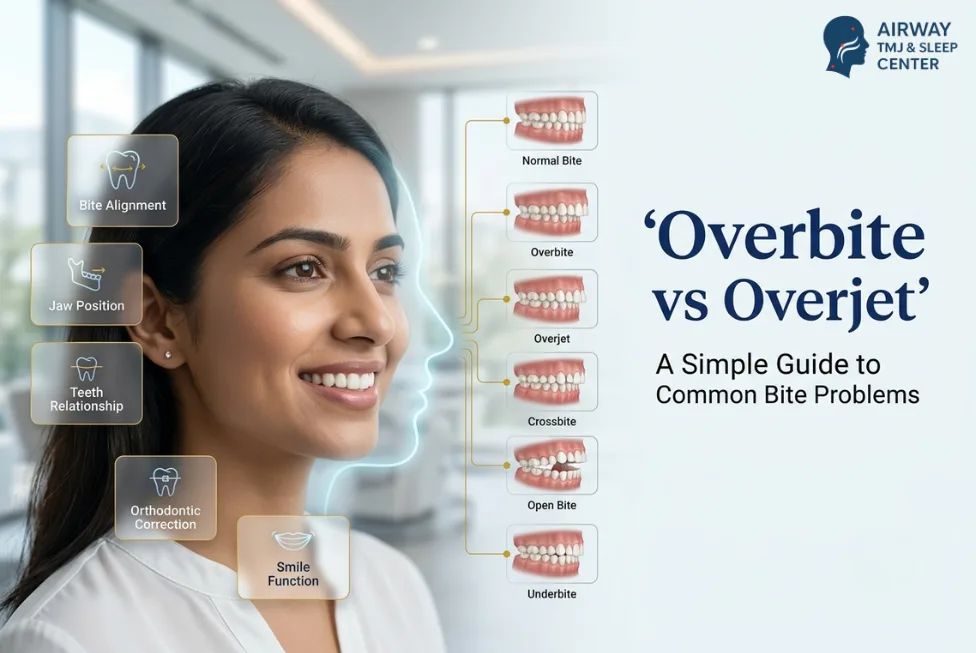
Quick answer: An overbite is a vertical problem – your upper front teeth overlap the lower ones too much (top teeth sit too far down). An overjet is a horizontal problem – your upper front teeth stick out forward over the lower ones (often called ‘buck teeth’). An underbite is when the lower teeth sit in front of the upper ones, and a crossbite is when some upper teeth bite inside the lower ones. All are types of malocclusion (a bad bite), and most are treatable with braces or aligners – and correcting them can also protect your jaw joint.
| Key takeaways
✓ Overbite = vertical overlap (top teeth too far down); overjet = horizontal stick-out (‘buck teeth’). ✓ Underbite = lower teeth in front; crossbite = upper teeth bite inside the lower; open bite = front teeth don’t touch. ✓ These are all types of malocclusion – a misaligned bite – which is very common. ✓ Causes include genetics, thumb-sucking, tongue thrusting and mouth breathing in childhood. ✓ A bad bite isn’t only cosmetic – a deep overbite, in particular, is linked to TMJ pain and jaw strain. |
Overbite vs Overjet: The Key Difference
This is the pair people confuse most, so let us settle it simply. The difference is direction:
- Overbite is vertical. Look at your front teeth from the side. If the upper front teeth overlap too far down over the lower ones, that is an overbite. A small overlap is normal; a deep overbite is when the top teeth cover most of the bottom teeth.
- Overjet is horizontal. If the upper front teeth point or stick out forward, away from the lower teeth, that is an overjet – commonly called ‘buck teeth’. It is measured as the horizontal gap between the upper and lower front teeth.
In short: overbite is how far the top teeth come down; overjet is how far they stick out. You can have one, the other, or both at once.
The Main Types of Bite Problems
Here are the common bite problems at a glance, with how to spot each one.
| Bite problem | What it is | How to spot it |
| Overbite | Upper front teeth overlap the lower ones too far vertically | Top teeth cover most of the bottom teeth when you bite |
| Overjet | Upper front teeth stick out forward (‘buck teeth’) | A horizontal gap; upper teeth point outward |
| Underbite | Lower teeth sit in front of the upper teeth | The lower jaw and teeth jut forward |
| Crossbite | Some upper teeth bite inside the lower teeth | Teeth don’t line up; often a narrow upper jaw |
| Open bite | Front teeth don’t touch when the back teeth do | A visible gap between upper and lower front teeth |
A note on the umbrella term: all of these fall under malocclusion, which simply means the teeth do not meet correctly. It is extremely common – some degree of malocclusion affects most people – and not every case needs treatment. It matters when it affects how you function, your oral health, or your comfort.
What Causes Bite Problems?
Most bite problems come from how the teeth and jaws grow, shaped by a mix of genetics and habits:
- Jaw size and shape are inherited, so bite problems often run in families.
- Childhood habits. Prolonged thumb-sucking, dummy use, and tongue thrusting can push teeth out of position.
- Mouth breathing. Chronic mouth breathing in childhood can affect how the jaws and palate develop, contributing to a narrow upper jaw and crossbite.
- Increased nasal resistance. When the nose is constantly blocked – from allergies, enlarged adenoids, or a deviated septum – breathing shifts to the mouth, which alters tongue posture and jaw growth and can push the bite off track.
- Jaw growth mismatch. When the upper and lower jaws grow at different rates, the bite ends up uneven.
- Injury or early tooth loss. These can shift the bite over time.
Because mouth breathing is a contributing factor, this links closely to mouth breathing in children – addressing it early can support healthier jaw development.
Why Bite Problems Matter (Including the TMJ Link)
A bad bite is not only about appearance. When teeth and jaws do not meet correctly, it can affect daily function and long-term health:
- Harder to clean teeth properly, raising the risk of decay and gum problems.
- Uneven wear on the teeth, and difficulty chewing or speaking clearly.
- Strain on the jaw muscles and joints.
The TMJ connection is the one most people miss. A deep overbite, in particular, pushes the lower jaw and chin backwards towards the jaw joint. That can place extra strain on the temporomandibular joint, contributing to jaw pain, clicking, and headaches – and a recessed lower jaw can also reduce the space in the airway, affecting breathing and sleep. This is exactly why correcting a problem bite can do far more than improve a smile.
If you have jaw pain or clicking alongside a bite problem, see our guide to TMJ disorders.
How Are Bite Problems Treated?
The right treatment depends on the type and severity of the bite problem, and your age. The main options:
- The traditional, versatile option – well suited to complex bite corrections.
- Clear aligners. A discreet, removable option for many mild-to-moderate overbite, overjet, spacing and crowding cases.
- Growth guidance in children. Treating early, while the jaws are still developing, can steer growth and sometimes avoid more complex treatment later.
- Reserved for severe skeletal cases where the jaws themselves need repositioning.
The key principle: a bite should be corrected with the jaw joint in mind, not just the look of the teeth. Aligning the bite to how your jaw naturally rests gives a result that is comfortable and stable, and protects the TMJ.
This is the heart of neuromuscular orthodontics, and you can read more about
| When to get a bite problem checked
✓ Jaw pain, clicking, or headaches alongside an uneven bite ✓ Difficulty biting, chewing, or speaking clearly ✓ Front teeth that stick out, don’t meet, or bite the wrong way ✓ A child with a developing bite problem, thumb-sucking, or mouth breathing ✓ You’re considering braces or aligners and want a bite-aware plan |
Why Choose Airway TMJ & Sleep Center in Noida
Bite problems sit at the meeting point of orthodontics, the jaw joint, and the airway – which is exactly the focus at Airway TMJ and Sleep Center in Noida. Dr. Kishlay Gaur assesses not just how your teeth look, but how your bite, jaw, and airway work together, and plans correction with a neuromuscular, bite-aware approach. The goal is a result that is straight, comfortable, and protective of your jaw and breathing – not just cosmetically tidy.
The Bottom Line
Overbite, overjet, underbite, crossbite and open bite are all types of a misaligned bite – and the difference between them decides how each is best treated. Overbite is vertical overlap; overjet is horizontal stick-out. Most are very treatable with braces or aligners, and correcting them does more than improve a smile – it can protect your jaw joint and your breathing. If you are unsure which applies to you, or you have jaw pain alongside it, a proper assessment is the best place to start.
Book a bite and jaw assessment in Noida to find out exactly what’s happening with your bite – and the most comfortable way to correct it.