
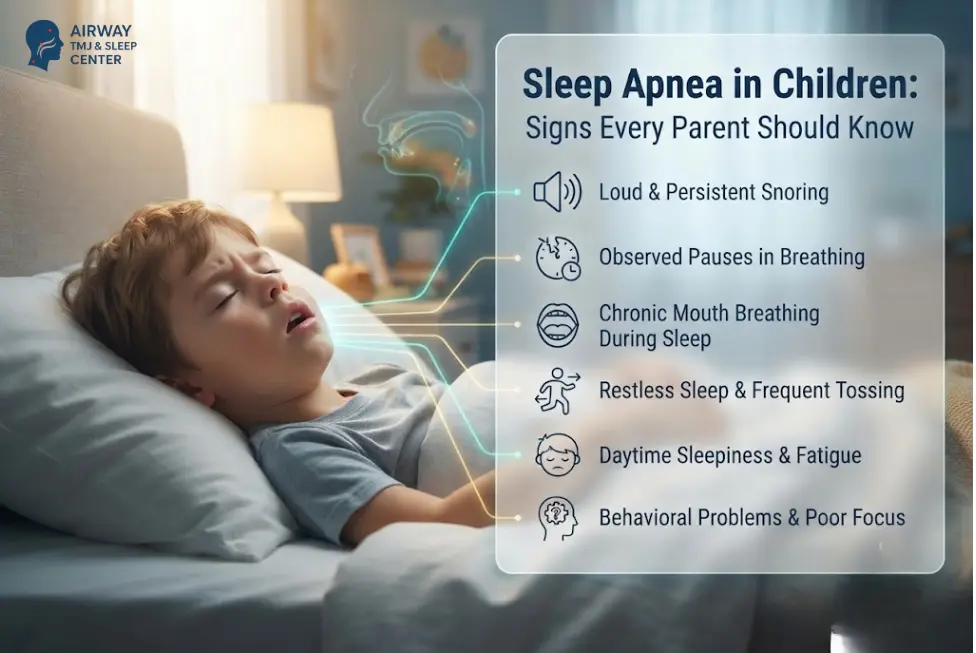
Sleep Apnea in Children: Signs Every Parent Should Know
Medically reviewed by Dr. Kishlay Gaur, FICCMO Fellow — TMJ, Orofacial Pain & Dental Sleep specialist, Airway TMJ & Sleep Center, Noida (Delhi NCR).
A child who snores night after night, breathes through the mouth, sleeps restlessly, or seems hyperactive and unfocused by day may not simply be a noisy sleeper. These can be signs of pediatric sleep-disordered breathing — including obstructive sleep apnea — a condition estimated to affect around 2–5% of children. Because children often show it through behaviour rather than daytime sleepiness, it is frequently mistaken for something else. The reassuring part: caught early, it usually responds well to gentle, non-surgical, airway-focused care, coordinated with your child’s paediatrician and ENT.
As parents, we tend to be reassured by a child who “sleeps like a log” — even a snoring one. But loud, regular snoring in a child is not normal, and it is one of the most common signs that a child’s airway is under strain during sleep. Knowing what to look for is the first step to getting ahead of a problem that quietly affects behaviour, learning, growth, and even the way a child’s face and jaw develop.
What is sleep apnea in children?
Obstructive sleep apnea (OSA) in children happens when the upper airway becomes partly or fully blocked during sleep, so breathing is repeatedly interrupted. It sits at the more serious end of a wider spectrum called sleep-disordered breathing, which ranges from habitual snoring and mouth breathing to frequent pauses in breath. The problem tends to peak between the ages of 2 and 8 — the years when the tonsils and adenoids are largest relative to a child’s small airway. Unlike adults, children rarely say they feel tired; instead, the effects show up in their mood, behaviour, and focus.
Why it’s so easily missed
Here is the part that surprises most parents. A sleep-deprived adult slows down and feels sleepy. A sleep-deprived child often speeds up. Fragmented sleep and dips in overnight oxygen interfere with the developing prefrontal part of the brain — the area responsible for attention, impulse control, and self-regulation. The result can look a great deal like attention or behaviour problems. Research consistently links pediatric OSA with hyperactivity, inattention, irritability, and poorer school performance — and studies show these behaviours often improve once the breathing problem is treated. This is why a child labelled “hyperactive” or “always distracted” sometimes turns out to have an airway problem at the root.
Signs every parent should watch for
The signals split neatly into what you notice at night and what you notice during the day.
At night, you may notice:
- Loud or regular snoring
- Mouth breathing during sleep
- Pauses, gasping, or choking sounds
- Restless, sweaty, tossing sleep
- Neck arched back / unusual sleep positions
- Teeth grinding at night
- Bedwetting that returns after being dry
During the day, you may notice:
- Hyperactivity or trouble sitting still
- Difficulty focusing; slipping grades
- Irritability or mood swings
- Morning headaches
- A constantly open mouth, dry lips
- Tiredness — or, oddly, over-energy
- Slower growth than expected
No single sign confirms a diagnosis. But a cluster of them — especially regular snoring together with daytime behaviour changes — is worth a professional look.
What causes sleep apnea in children?
- Enlarged tonsils and adenoids — the single most common cause; these tissues can crowd a small airway.
- A narrow jaw or high, narrow palate — leaving less room for the tongue and airway.
- Chronic mouth breathing — often from blocked nasal breathing (allergies, congestion), which also changes how the jaw and face grow.
- Allergies and persistent nasal congestion.
- Being overweight, which can add soft tissue around the airway.
Often it is a combination. And importantly, the shape of a child’s jaw and airway is still developing — which is exactly why early, growth-guided care can make such a difference.
Why early treatment matters
Childhood is a window. The face, jaws, and airway are still growing, and that growth can be gently guided while it is happening. Left unaddressed, sleep-disordered breathing can affect a child’s behaviour and learning during crucial years, reinforce mouth breathing that narrows the developing jaw, and set patterns that are harder to change later. Addressing it early does more than improve tonight’s sleep — it supports healthy development of the airway, bite, and face for years to come.
How we assess your child’s airway in Noida
At Airway TMJ & Sleep Center in Noida, a children’s airway evaluation looks at the whole picture — how your child breathes, how the jaw and palate are developing, and how well they sleep. Where helpful, we use airway analysis and imaging to see how open the airway is and how the jaws are growing. When obstructive sleep apnea is suspected, the diagnosis is confirmed with a sleep study, and we work alongside your child’s paediatrician and ENT so every angle is covered. The aim is a clear, measurable understanding of what is happening — not guesswork.
Treatment options
Treatment is always tailored to the child and the cause, and it is usually gentle and non-surgical. Depending on the diagnosis, a plan may involve:
- Removing enlarged tonsils or adenoids — where an ENT finds this is the main cause, it is often the first-line medical step and can bring significant improvement.
- Palatal (jaw) expansion — a gentle orthodontic appliance that widens a narrow upper jaw, opens the nasal passages, and creates more room for airflow, supporting natural nasal breathing.
- Myofunctional therapy — simple exercises that retrain the tongue, lips, and breathing muscles to rest and work correctly.
- Correcting mouth breathing and its triggers — often in coordination with an ENT or allergist.
Frequently the best results come from combining approaches — for example, expansion to make space, plus myofunctional therapy to build the right habits. Every plan is coordinated with your child’s other doctors, and individual results may vary.
When to see a specialist
If your child snores most nights, breathes through the mouth, sleeps restlessly, or shows unexplained daytime hyperactivity or focus problems, it is worth having their airway assessed — the earlier the better. A short evaluation can bring real clarity, and often real relief.
Book a children’s airway evaluation in Noida
If you have noticed these signs in your child, an early check is one of the most valuable things you can do for their sleep, growth, and focus. Book a consultation — no pressure, no obligation.
Visit our main website: airwaytmjsleep.com
Healing Jaws. Restoring Sleep. Transforming Lives.