
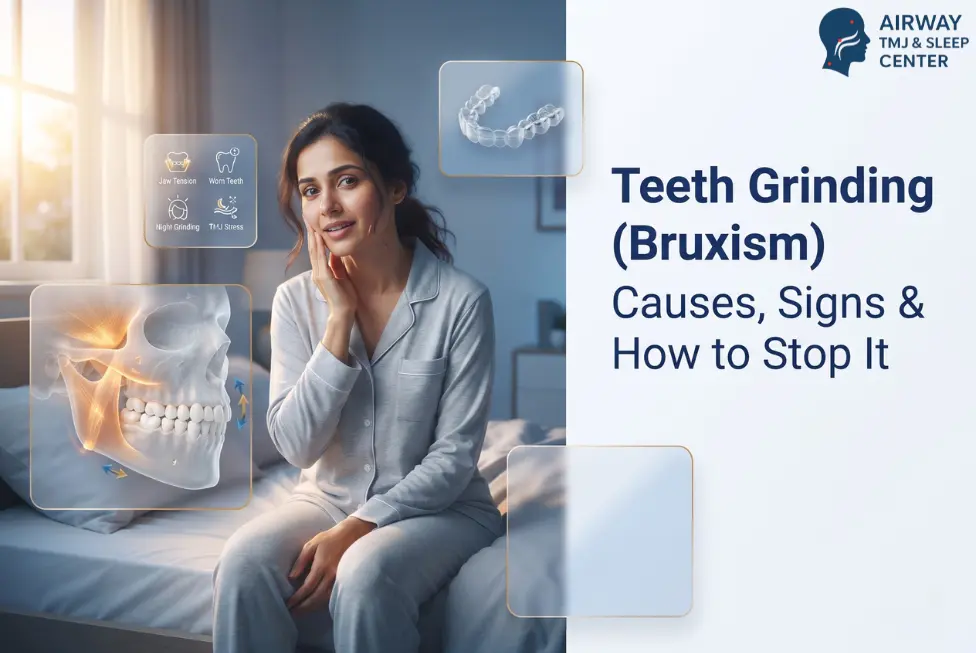
If you wake up with a sore jaw, a dull headache, or sensitive teeth — or your partner hears grinding at night — you may have bruxism, the medical name for teeth grinding and clenching. It is common, often unnoticed, and easy to dismiss. But persistent teeth grinding can wear down your teeth, strain your jaw, and, importantly, can be a warning sign of a hidden airway or sleep problem.
This guide explains what causes teeth grinding, how to recognise it, why it is so closely linked to sleep and breathing, and how to stop it. At Airway TMJ & Sleep Center in Noida, we look beyond the symptom to the root cause — because treating the cause is what makes relief last.
What is teeth grinding (bruxism)?
Teeth grinding, or bruxism, is the involuntary grinding, gnashing or clenching of the teeth. It can happen while you are awake (awake bruxism) or during sleep (sleep bruxism). Many people don’t know they do it until a partner notices the noise or a dentist spots worn teeth.
Bruxism is not a habit you consciously choose. It is repetitive jaw-muscle activity that grinds the teeth together or clenches them with force. Because it often happens during sleep, most people are unaware of it — which is why it frequently goes undiagnosed until teeth are worn or the jaw starts to hurt.
What is the difference between awake and sleep bruxism?
Awake bruxism is usually clenching during the day, often tied to stress, concentration or focus. Sleep bruxism is rhythmic grinding during sleep, more linked to sleep arousals and breathing. They have different triggers, so identifying which you have guides the right treatment.
The distinction matters. Awake bruxism tends to be silent clenching during stressful or focused moments — driving, working, scrolling. Sleep bruxism is the grinding that disturbs a partner’s sleep, and it is closely connected to how your brain and airway behave overnight. Some people have both, but the treatment emphasis differs for each.
What causes teeth grinding?
Teeth grinding has several causes that often overlap: stress and anxiety, sleep-related breathing problems such as snoring or sleep apnea, an uneven bite, certain medications and stimulants (caffeine, nicotine, alcohol), and lifestyle factors. In many adults, an airway or sleep trigger is a major, overlooked driver.
- Stress, anxiety and a ‘wired,’ tense nervous system — a leading cause of daytime clenching.
- Sleep-related breathing problems — snoring and obstructive sleep apnea (a major, under-recognised cause of sleep grinding).
- An uneven bite or jaw-alignment issues that the muscles try to compensate for.
- Caffeine, nicotine, alcohol and some medications that disturb sleep.
- Disturbed, fragmented sleep from any cause.
Is teeth grinding linked to sleep apnea?
Yes — strongly. Research shows nearly half of adults with obstructive sleep apnea also have sleep bruxism. When the airway narrows or collapses during sleep, the brain can clench the jaw to reopen it, producing grinding. So night-time grinding can be a red flag for an underlying breathing problem.
This is one of the most important and least-known facts about bruxism. During sleep apnea, breathing repeatedly pauses; to reopen the airway, the brain triggers a micro-arousal that often tightens the jaw muscles — producing a burst of grinding. In other words, the grinding may be the body’s attempt to protect its own breathing. That is why, at an airway-focused clinic, we treat night-time grinding as a possible window into your sleep and airway health, not just a dental nuisance.
Why this matters: If sleep apnea is driving your grinding, a night guard alone won’t solve it — and the untreated apnea carries its own health risks. Screening the airway can change the whole treatment plan.
What are the signs and effects of bruxism?
Common signs include a sore or tired jaw, morning headaches, worn, flattened or sensitive teeth, clicking or aching in the jaw joint, disrupted sleep and cheek or tongue indentations. Over time, untreated grinding can crack teeth, loosen fillings and contribute to TMJ disorders.
| Where you feel it | Common signs |
| Jaw & face | Sore, tired or tight jaw; aching cheeks; jaw clicking |
| Head | Morning headaches or temple pain |
| Teeth | Worn, flattened, chipped or sensitive teeth; cracked fillings |
| Sleep | Grinding noise at night; unrefreshing sleep; a tired partner |
| Mouth | Indentations on the tongue; ridging inside the cheeks |
How do you stop grinding your teeth?
Stopping teeth grinding means protecting the teeth and treating the cause. A custom night guard or orthotic shields the teeth and eases the jaw; alongside it, address the driver — screen for sleep apnea, manage stress, improve sleep habits, and correct an uneven bite. Treating the cause is what makes it stop.
The most effective approach combines protection with cause-focused care:
- Protect the teeth and calm the jaw with a custom-fitted night guard or orthotic (not a generic, store-bought guard).
- Screen the airway — if snoring or sleep apnea is present, treating it can dramatically reduce or even resolve the grinding.
- Address stress and the nervous system with relaxation, posture and daytime clenching awareness.
- Review caffeine, alcohol, nicotine and sleep habits that worsen grinding.
- Correct an uneven bite where it is contributing, through a bite-aware (neuromuscular) plan.
What happens if teeth grinding is left untreated?
Quick answer: Untreated bruxism can wear down and crack teeth, loosen fillings and crowns, trigger chronic jaw pain and headaches, and contribute to TMJ disorders. If a sleep-breathing problem is the cause, leaving it untreated also carries wider health risks — so early diagnosis protects both your teeth and your health.
Grinding is forceful and relentless. Over months and years it flattens and cracks teeth, breaks down dental work, and overloads the jaw joint and muscles — a common route into a TMJ disorder, headaches and facial pain. And when the hidden driver is sleep apnea, ignoring it means leaving a condition linked to heart and metabolic risks untreated. Acting early is far simpler than repairing the damage later.
How does Airway treat teeth grinding?
Quick answer: Airway TMJ & Sleep Center looks for the root cause. We use objective diagnostics — jaw tracking, EMG, CBCT and airway analysis — to check the bite and screen for sleep-breathing problems, then combine a custom orthotic with cause-focused care. Treating the airway and bite, not just the teeth, is what makes grinding stop.
Rather than handing over a guard and hoping, our team in Noida investigates why you grind. We assess how your jaw muscles work, examine your bite, and screen your airway and sleep — because so much night-time grinding traces back to breathing. From there we build a personalised plan that protects your teeth and treats the real driver, so the grinding settles for good.
Book a Bruxism & Airway Evaluation in Noida
Grinding your teeth, waking with a sore jaw, or sleeping poorly? Airway TMJ & Sleep Center finds the cause — bite or airway — and builds a plan that protects your teeth and helps you sleep better. Serving Noida and Delhi NCR.
📍 C-98/10, C Block Market, Sector 41, Noida 201301 | 📞 +91 87566 15325 | 🌐 airwaytmjsleep.com
Disclaimer: This article is for general education only and is not a substitute for professional medical or dental advice. Individual results vary; please seek an in-person evaluation.