
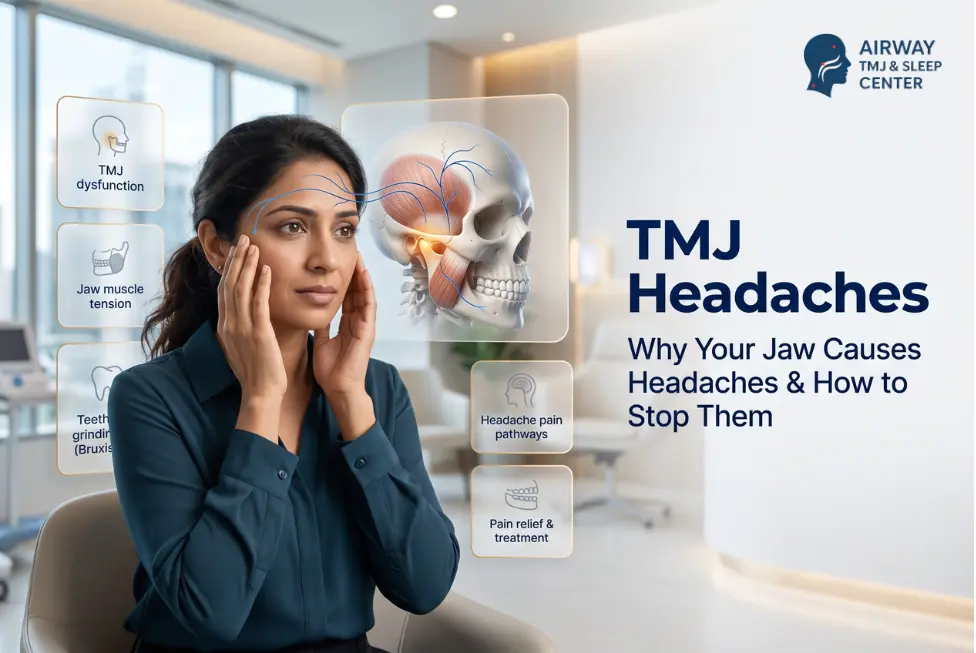
TMJ Headaches: Is Your Jaw Causing Your Headaches?
Quick answer: Yes – your jaw can absolutely cause headaches. When the temporomandibular joint (TMJ) is strained or your jaw muscles are overworked from clenching, that tension spreads to the temples, forehead, and behind the eyes, producing a TMJ headache. The important part most people miss: ordinary painkillers only dull these headaches. Until the underlying jaw problem is treated, they keep coming back – often at the same or greater frequency.
| Key takeaways
✓ TMJ headaches are real and common – they come from jaw-joint strain and overworked chewing muscles, not your sinuses or screen time alone. ✓ They usually sit around the temples and behind the eyes, and often travel into the neck and shoulders. ✓ They are frequently mistaken for tension headaches or migraines – and treated with the wrong remedy. ✓ Painkillers reduce severity but not frequency; treating the jaw is what actually breaks the cycle. ✓ Most cases improve with a custom oral appliance, jaw therapy, and habit change – no surgery required. |
What Is a TMJ Headache?
A TMJ headache is a head pain that originates from problems in the temporomandibular joint – the hinge that connects your lower jaw to your skull, just in front of each ear – and the muscles that move it. When that joint is misaligned or those muscles are constantly tense, the strain refers pain upward into the head. Because the pain shows up in the head rather than the jaw, people rarely connect the two, and the headaches get blamed on stress, dehydration, eye strain, or a long day.
In reality, the jaw is one of the most overlooked headache triggers. If you wake up with a dull, pressing headache, notice it worsening as the day goes on, or feel it flare when you chew, talk, or clench, your TMJ is a strong suspect.
How Can the Jaw Cause Headaches?
The link between jaw and head comes down to muscles and nerves working harder than they should. Three mechanisms are usually involved:
- Muscle overload. The chewing muscles around the temple and cheek (especially the temporalis and masseter) are large and powerful. When you clench or grind, they stay contracted for hours. Fatigued muscles ache – and that ache is felt as a headache across the temples and forehead.
- Nerve irritation. The TMJ sits right beside the trigeminal nerve, the main nerve carrying sensation from the face and head. An irritated, inflamed joint can stimulate this nerve, which is the same pathway involved in migraines – which is why TMJ pain can feel migraine-like.
- Posture and the neck. When the jaw is off-balance, the neck and shoulder muscles compensate. That added tension feeds head and neck pain, creating a cycle of jaw, neck, and head discomfort that reinforces itself.
What Does a TMJ Headache Feel Like?
TMJ headaches have a recognisable pattern. They typically start around the temples and jaw, then spread into the forehead, behind the eyes, and down into the neck. People often describe a feeling of pressure or tightness rather than a sharp, throbbing pain. Common signs include:
- A dull, pressing ache around the temples or behind the eyes, often on one side.
- Headaches that are worst in the morning (a clue to night-time clenching) or build through the day.
- Pain that flares when you chew, yawn, talk a lot, or clench.
- A tight, tired jaw, or clicking and popping when you open your mouth.
- Tenderness in the cheeks or temples, plus neck and shoulder stiffness.
- Aching or fullness in or around the ears, sometimes with no ear infection.
TMJ Headache vs Migraine vs Tension Headache
This is where many people – and even some clinicians – go wrong. TMJ headaches overlap with tension headaches and migraines, but the trigger and the treatment are different. The table below shows how to tell them apart.
| Feature | TMJ headache | Tension headache | Migraine |
| Usual location | Temples, behind eyes, jaw, spreading to neck | Band-like, both sides of the head | Often one side, deep and throbbing |
| Type of pain | Pressure / tightness, dull ache | Steady, mild-to-moderate pressure | Throbbing, moderate-to-severe |
| Jaw signs | Yes – clicking, tight jaw, worse on chewing | No specific jaw link | Sometimes, but not jaw-driven |
| Common trigger | Clenching, grinding, bite imbalance | Stress, posture | Light, sound, food, hormones |
| What actually helps | Treating the jaw (appliance, therapy) | Rest, stress relief | Migraine-specific medication |
The critical point: if a TMJ disorder is driving your headaches, the strongest headache medication will only manage how bad each episode feels – it will not reduce how often they happen. Lasting relief comes from addressing the jaw itself.
| See a TMJ specialist if you have
✓ Headaches several times a week that painkillers don’t truly resolve ✓ Morning headaches together with a tight or sore jaw ✓ Jaw clicking, popping, or locking alongside the headaches ✓ Headache pain that worsens when chewing or clenching ✓ Ear fullness, facial pain, or neck and shoulder tension with the headaches |
How to Relieve a TMJ Headache
Relief works on two levels: calming the current pain, and fixing the cause so the headaches stop returning. Start with simple self-care; move to professional treatment if the pattern persists.
Home remedies for fast relief
- Apply a warm compress to relax tight jaw and temple muscles, or a cold pack to numb sharp pain – about 15 minutes at a time.
- Gently massage the jaw, temples, and cheeks to ease muscle tension and improve blood flow.
- Rest the jaw: softer foods, smaller bites, and no gum or wide yawning during a flare.
- Keep teeth slightly apart during the day – lips together, jaw relaxed – to break the clenching habit.
- Use relaxation or breathing techniques to lower the stress that drives clenching.
Over-the-counter pain relievers such as ibuprofen can help short-term, but think of them as a bridge, not a fix.
Professional treatment that breaks the cycle
Because the headaches come from the jaw, lasting relief means treating the jaw:
- Custom oral appliance. A precisely fitted appliance takes pressure off the joint and stops night-time clenching – often the single most effective step for morning headaches.
- Neuromuscular evaluation and therapy. Measuring how your muscles and bite behave pinpoints the real driver, so treatment is targeted rather than guesswork.
- Bite correction. If an uneven bite is overloading the joint and muscles, correcting it removes the source of the strain.
- Jaw physiotherapy. Exercises and manual therapy relax overworked muscles and restore smooth, balanced jaw movement.
How Is a TMJ Headache Diagnosed?
Diagnosis focuses on confirming that the jaw is the source. A TMJ-focused assessment usually includes a history of your headache pattern and habits (clenching, grinding, stress), a hands-on exam of the jaw muscles and joint, an analysis of how your teeth meet, and – where needed – neuromuscular diagnostics to see muscle activity and jaw movement. This is what separates a focused TMJ practice from a routine appointment: the aim is to explain why the headaches happen, not just to confirm that they do.
Can You Prevent TMJ Headaches?
Often, yes – by removing the strain that sets them off:
- Treat night-time grinding early with a properly fitted appliance.
- Manage stress, since tension travels straight to the jaw and neck.
- Avoid gum and very hard or chewy foods that overload the joint.
- Keep good head and neck posture during long screen sessions.
- Address jaw clicking or a tight jaw before it turns into chronic headaches.
Why Choose Airway TMJ & Sleep Center in Noida
Headaches that come from the jaw need someone who understands the joint, the muscles, the bite, and posture together. At Airway TMJ & Sleep Center in Noida, Dr. Kishlay Gaur focuses specifically on TMJ and orofacial pain, using detailed neuromuscular diagnostics to find the real reason behind your headaches rather than masking them. The approach is non-surgical and personalised, designed to reduce how often the headaches happen – not just how much they hurt.
The Bottom Line
If you get frequent headaches around the temples or behind the eyes – especially with a tight jaw, morning pain, or clicking – your jaw may well be the cause. TMJ headaches are very treatable, but only when the jaw itself is addressed. Painkillers manage the symptom; treating the TMJ ends the cycle. If this pattern sounds familiar, it is worth getting your jaw checked.
Book a TMJ headache evaluation in Noida to find out whether your jaw is behind your headaches – and the simplest way to stop them.