
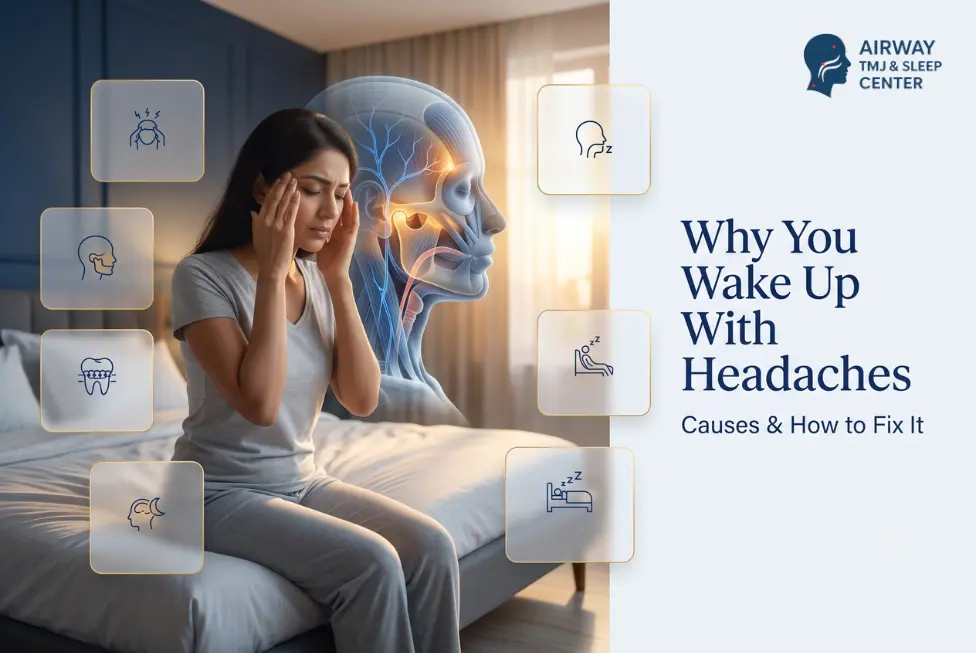
There are few worse ways to start the day than with a headache already in place. You have not even got out of bed, yet your head is throbbing, your temples feel tight, or there is a dull ache behind your eyes. If this happens to you regularly, it is not something to simply push through with a painkiller and a coffee. A headache that is there the moment you wake up is often a clue about what is happening to your body while you sleep.
The encouraging news is that most morning headaches have an identifiable cause, and the two most common treatable causes – night-time teeth grinding and sleep apnea – are very fixable. This guide explains why you wake up with headaches, how to work out which cause applies to you, and the practical steps that can finally let you wake up clear-headed.
Quick answer: Waking up with headaches is most often caused by what happens during sleep – especially night-time teeth grinding (which tires the jaw and temple muscles) and sleep apnea (where breathing pauses lower your oxygen). Poor or irregular sleep, alcohol, caffeine, medication overuse and dehydration are other common triggers. The clue is in the detail: a morning headache with a sore jaw points to grinding, while one with loud snoring and daytime tiredness points to sleep apnea. Both are very treatable.
| Key takeaways ✓ A headache that is present on waking usually reflects something happening during sleep. ✓ The two most common treatable causes are night-time teeth grinding and sleep apnea. ✓ A sore, tight jaw on waking points to grinding; loud snoring and tiredness point to sleep apnea. ✓ Poor sleep, alcohol, caffeine, dehydration and overusing painkillers can all cause morning headaches. ✓ Frequent morning headaches deserve a proper assessment – they are usually very fixable. |
Why Morning Headaches Are Worth Paying Attention To
Headaches that appear during the day usually have an obvious trigger – a skipped meal, a stressful afternoon, hours at a screen. A headache that is already there when you open your eyes is different. It suggests that the cause was acting overnight, while you were asleep and unaware of it. That is exactly why morning headaches are such a useful signal: they point towards sleep-related causes that are easy to miss but very treatable once identified.The Common Causes of Morning Headaches
Morning headaches are not one condition with one cause. The table below summarises the usual culprits, the tell-tale clues for each, and how each is generally addressed.| Cause | Tell-tale clues | How it’s addressed |
| Teeth grinding (bruxism) | Sore, tight jaw on waking, temple pain, worn or sensitive teeth | Custom night guard, jaw care, stress management |
| Sleep apnea | Loud snoring, gasping or pauses in breathing, daytime exhaustion | Oral appliance or CPAP; airway treatment |
| Too little or poor sleep | Headache after short or broken nights; worse during stress | Consistent sleep schedule, sleep hygiene |
| Oversleeping / lie-ins | Headache after sleeping much longer than usual | Keep a steady wake-up time |
| Alcohol the night before | Headache with dehydration, after evening drinking | Limit alcohol, hydrate before bed |
| Caffeine pattern | Headache on mornings after high or skipped caffeine | Keep caffeine steady and not too late |
| Medication overuse | Daily early-morning headache in frequent painkiller users | Review painkiller use with a doctor |
| Other medical causes | High blood pressure, anxiety/depression, or specific headache disorders | Medical assessment |
The Two Causes Most People Miss
Among all these, two stand out – because they are common, they happen silently overnight, and they are highly treatable. They are also frequently linked: around a quarter of people with sleep apnea also grind their teeth.1. Night-time teeth grinding (bruxism)
If you clench or grind your teeth in your sleep, the large chewing muscles that run up into your temples stay contracted for hours. Like any overworked muscle, they ache – and that ache is felt as a headache across the temples and forehead, often with a tight, tired jaw. The clues are clear: a morning headache that comes with jaw soreness, temple tightness, or worn and sensitive teeth strongly suggests grinding. This is closely related to TMJ disorders. For the full picture of how the jaw produces head pain, see our guide to TMJ headaches, and how a fitted night guard helps.2. Sleep apnea
Sleep apnea is a powerful and often overlooked cause of morning headaches. When breathing repeatedly pauses overnight, oxygen levels fall and carbon dioxide rises, which widens the blood vessels in the head and produces a headache that is typically present on waking and eases over the next hour or two. The numbers tell the story: studies suggest that between ten and thirty percent of people with untreated sleep apnea wake with morning headaches, compared with about five percent of the general population. If your morning headaches come with loud snoring, gasping, or daytime exhaustion, read our guide to sleep apnea symptoms and risks – it is very treatable, often with a comfortable oral appliance.Can a Lack of Sleep Cause Headaches?
Yes – and it works both ways. Too little sleep, or broken, poor-quality sleep, is a well-recognised trigger for tension headaches and migraines. In fact, migraines are several times more likely in people with sleep disorders, and in large studies around half of migraine sufferers say sleep disturbance contributes to their attacks. Frustratingly, the relationship is a loop: poor sleep brings on headaches, and headaches make it harder to sleep. Oversleeping can do it too – a weekend lie-in that breaks your usual rhythm can leave you with a headache as well.How to Tell Which Cause Is Yours
The detail around your headache is the best clue. Ask yourself what else is happening:- Sore, tight jaw or worn teeth? Think night-time grinding.
- Loud snoring, gasping, or always exhausted? Think sleep apnea.
- Headache after short, late, or broken nights? Think poor or insufficient sleep.
- Headache after evening drinking? Think alcohol and dehydration.
- Taking painkillers most days? Medication-overuse headache is possible – speak to a doctor.
How to Stop Waking Up With Headaches
Start with the basics that help almost everyone, then address the specific cause.- Keep a consistent sleep schedule. The same bedtime and wake-up time, aiming for at least seven hours, steadies the system that triggers many morning headaches.
- Limit alcohol and late caffeine. Both disrupt sleep and dehydrate you; keep caffeine earlier and steady day to day.
- Hydrate and wind down. A glass of water before bed and a calm pre-sleep routine reduce two common triggers.
- Address grinding. If you wake up with a sore jaw, a comprehensive airway, TMJ and associated muscular evaluation is needed to find the root cause of the grinding. Based on this, an airway-augmentation plan is created – which may involve shifting the bite from its habitual position to a functional position, addressing the lower facial height, creating functional tongue space, and assessing tongue mobility and range. Where needed, a sleep appliance is added to your night-time routine so the airway stays more open (patent) through the night. When the brain receives its optimal share of oxygen, it rarely tightens the jaw muscles that drive night-time teeth grinding – known as bruxism.
- Treat sleep apnea. Treating apnea often clears brain fog, daytime drowsiness, fatigue and focus problems, eases many psychological issues such as anxiety, nervousness, depression and mood swings, and helps address metabolic disorders like hypertension and diabetes more effectively.
- Review your painkiller use. Taking pain relief most days can itself cause morning headaches; a doctor can help you break the cycle.
| See a doctor promptly if your morning headaches ✓ Happen most days, or are getting more frequent or severe ✓ Come with loud snoring, gasping, or pauses in breathing at night ✓ Are new and you are over 50, or come with vision changes, weakness, or confusion ✓ Are sudden and severe (‘the worst headache of your life’) – seek emergency care ✓ Don’t improve despite better sleep habits |