
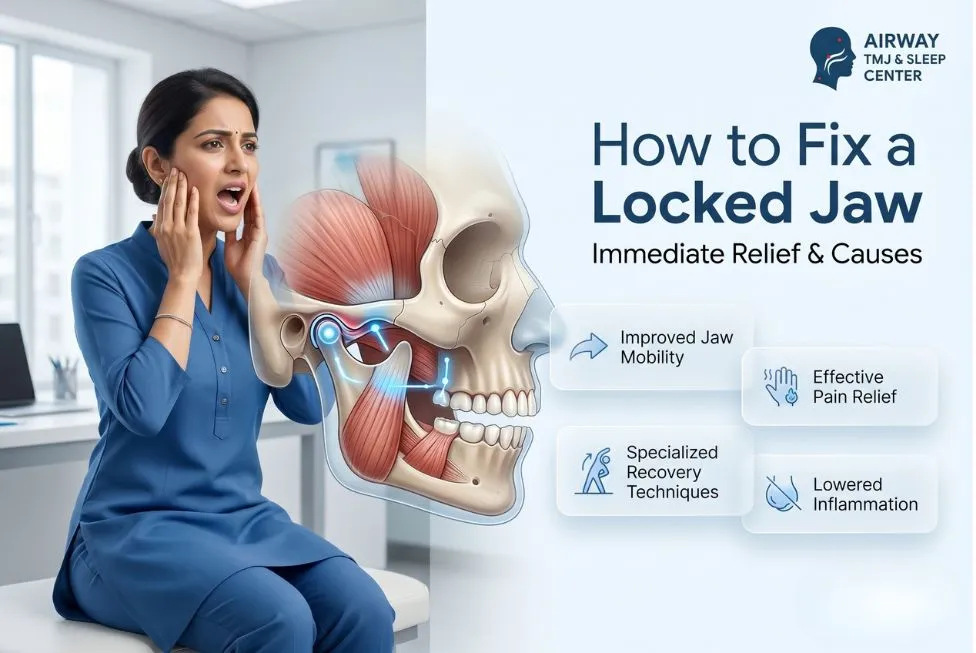
How to Fix a Locked Jaw: Immediate Relief, Causes, and When to Worry
A jaw that suddenly locks – stuck open after a big yawn, or stuck closed so you can’t open more than a finger’s width – is frightening. The instinct is to force it, but that’s exactly what you shouldn’t do. The good news is that most locked jaws are caused by the TMJ (the jaw joint) and can often be gently eased at home, especially if you stay calm and act early.
This guide gives you the immediate steps to try right now, explains what’s actually happening and why, covers the difference between a TMJ locked jaw and the very different (and serious) ‘lockjaw’ of tetanus, and tells you exactly when to seek urgent help.
| Jaw locked right now? Try this – gently
1. Stay calm. Stress tightens the jaw muscles and makes it harder to unlock – take slow breaths. 2. Apply warmth. Hold a warm compress to the joint for 10-15 minutes to relax the muscles. 3. Massage gently. With 2-3 fingers just below the cheekbone, knead in small circles for a few minutes. 4. Wiggle, don’t force. With the jaw relaxed, place your palms on each side and gently move it side to side and back – sometimes the disc slips back into place. 5. Ease pain if needed. An over-the-counter anti-inflammatory (as directed) can reduce pain and swelling. 6. Never force it open or shut. If it won’t ease within a short while, contact a TMJ professional – the best chance to unlock is in the first few days. |
Quick answer: A locked jaw is usually caused by the disc inside the TMJ slipping out of place, so the joint can’t move normally. To ease it, stay relaxed, apply heat, gently massage and wiggle the jaw – never force it. If it doesn’t release, see a TMJ specialist promptly, because unlocking is far easier in the first few days. A jaw that is stiffening with muscle spasms after a wound, with fever, is different – that needs emergency care.
What Is a Locked Jaw?
A locked jaw – often called lockjaw – means the lower jaw gets stuck and won’t move normally. With a TMJ disorder, this happens because the small cushioning disc inside the joint shifts out of position and doesn’t slip back as it should, so the joint jams. There are two types:
| Type | What happens | What you notice |
| Closed lock (most common) | The disc blocks full opening | You can only open about one finger-width instead of two; the jaw feels stuck shut |
| Open lock | The jaw is stuck forward and won’t close | You can’t bring your teeth together; often after a wide yawn |
What Causes the Jaw to Lock?
Almost anything that pushes the TMJ out of alignment can lead to locking. The common culprits:
- Disc displacement. The main cause – the disc slips forward and the jaw catches on it instead of gliding.
- Clenching and grinding (bruxism). Constant muscle tension strains the joint and sets the stage for locking.
- Tight, clenched muscles both trigger locking and make it harder to release.
- A wide yawn or large bite. Opening too far can pop the jaw out of position, causing an open lock.
- A blow or trauma to the jaw can displace the disc or joint.
- Inflammation or wear in the joint affects how smoothly it moves.
Locking on just one side is common – the two joints rarely behave identically, and one disc may be more displaced than the other.
Important: TMJ Lockjaw vs Tetanus Lockjaw
The word ‘lockjaw’ is used for two completely different things, and it’s important not to confuse them.
| TMJ lockjaw vs tetanus – know the difference
✓ TMJ lockjaw: caused by the jaw joint or muscles (disc displacement, clenching, injury). NOT life-threatening. Usually lasts hours to a few days. Eased with relaxation, heat, gentle movement, and TMJ care. ✓ Tetanus lockjaw: caused by a bacterial infection, usually after a wound. Begins with gradually worsening muscle spasms that spread from the jaw through the body, often with fever. It can be life-threatening and needs EMERGENCY medical care – not TMJ treatment. |
In short: if your jaw locked while yawning, chewing, or during a stressful period – and you have a history of jaw clicking or clenching – it’s almost certainly a TMJ issue. But if your jaw is progressively stiffening with spasms after a cut or wound, especially with fever, treat it as a medical emergency and get help immediately.
How Long Does a Locked Jaw Last – and Why Acting Fast Matters
A TMJ-related locked jaw is usually temporary. An acute flare often eases within a few hours to a few days, and only rarely lingers for weeks. But here’s the key: the sooner you get help, the better. The best chance of fully unlocking the joint and restoring normal movement is within the first few days, before the disc and surrounding tissues settle into the displaced position. Leaving a closed lock untreated for too long can make it harder to reverse, so don’t simply wait it out if gentle home measures aren’t working.
Professional Treatment for a Locked Jaw
If home measures don’t release the jaw, or it keeps recurring, a TMJ specialist has effective options – almost all non-surgical:
- Gentle manipulation. A trained clinician can often guide the jaw and disc back into position with a specific technique.
- Custom oral appliance. A splint or night guard reduces clenching, takes pressure off the joint, and helps prevent the lock returning.
- Therapy and exercises. To restore movement and retrain the jaw once the acute lock has eased.
- Targeted measures. In selected cases, joint injections or other procedures; surgery is rarely needed.
How to Stop Your Jaw From Locking Again
- Treat the underlying TMJ problem – locking is a sign the joint needs attention, not a one-off.
- Avoid opening too wide; support your chin during yawns and take smaller bites.
- Reduce clenching and grinding, with a night guard if needed.
- Manage stress, which feeds the muscle tension behind locking.
- Eat softer foods and rest the jaw during flare-prone periods.
| Seek urgent care if
✓ Your jaw is locked and won’t release despite gentle measures – see a TMJ professional promptly ✓ Jaw stiffness with muscle spasms develops after a wound, especially with fever – this is a medical emergency (possible tetanus) ✓ The lock followed a significant injury or blow to the jaw ✓ There is severe pain, swelling, or you cannot eat or drink |
Why Choose Airway TMJ & Sleep Center in Noida
A locked jaw is a clear signal that the joint needs expert attention – and quickly. At Airway TMJ & Sleep Center in Noida, Dr. Kishlay Gaur specialises in TMJ disorders and uses detailed neuromuscular diagnostics to release the lock, find why it happened, and treat the root cause non-surgically – so it’s far less likely to return. Because timing matters with a locked jaw, getting seen early gives you the best chance of a full, comfortable recovery.
The Bottom Line
A locked jaw is alarming but usually treatable – and almost always a TMJ issue rather than anything sinister. Stay calm, use heat and gentle movement, and never force it. If it won’t release, see a TMJ specialist quickly, because the first few days are the best window to fully unlock the joint. And keep the one safety rule in mind: a jaw stiffening with spasms after a wound is a different, urgent problem that needs emergency care.
Book a TMJ evaluation in Noida – especially if your jaw has locked or keeps catching, where acting early makes all the difference.