
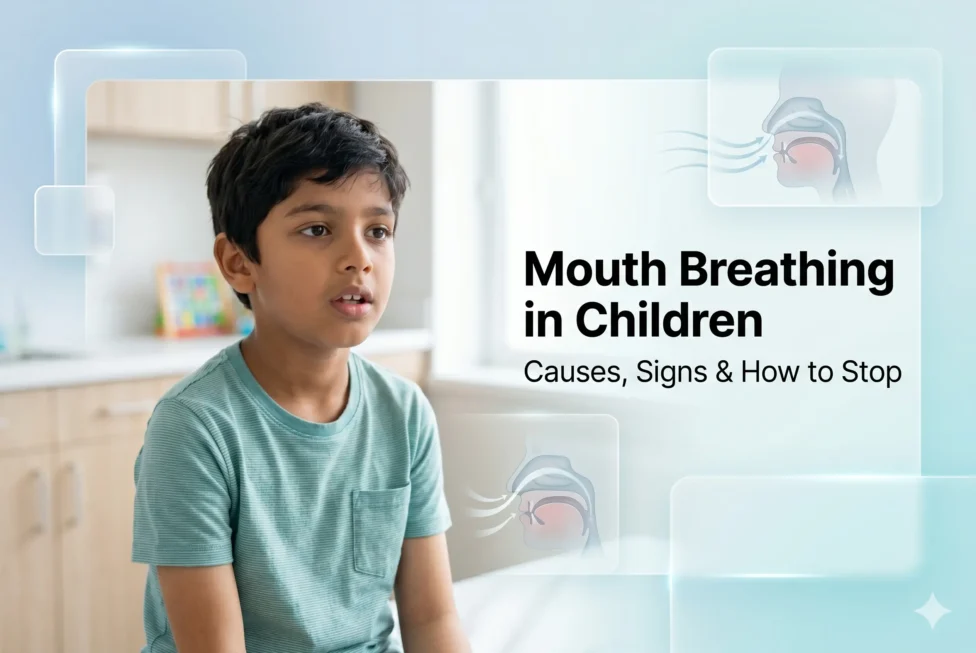
Mouth Breathing in Children: Causes, Signs, and How to Stop It
You glance at your child asleep – mouth wide open, lips dry, maybe a soft snore – and think nothing of it. It looks peaceful, even sweet. But if your child breathes through their mouth most of the time, day or night, it’s worth paying attention. What looks like a harmless habit can quietly affect how their face grows, how well they sleep, and even how they focus and behave during the day.
The good news, and the reason this matters so much, is that childhood is the window when this is easiest to fix. The face and jaws are still growing, so guiding a child back to healthy nasal breathing early can change the course of their development. This guide explains what causes mouth breathing, the signs to look for, why it’s more than a habit, and exactly how to help your child breathe better.
Quick answer: Mouth breathing in children is usually caused by something blocking the nose – most often enlarged adenoids or tonsils, allergies, or chronic congestion – or by habit. Left unaddressed during the growing years, it can affect facial and dental development, sleep quality, and concentration. It’s very treatable: the key is finding and treating the cause (often with an ENT, allergy care, and myofunctional therapy) and encouraging nasal breathing early.
| Key takeaways
✓ Mouth breathing is often a sign the nose is blocked – commonly by adenoids, tonsils, or allergies. ✓ It is more than a habit: during growth it can affect the face, teeth, sleep, and focus. ✓ Watch for open-mouth sleeping, snoring, dry lips, dark circles, and daytime tiredness. ✓ It can mimic ADHD – poor concentration and restlessness can stem from poor sleep. ✓ It is very treatable, and earlier is better – treat the cause and retrain nasal breathing. |
What Is Mouth Breathing – and Why Do Kids Do It?
We’re designed to breathe through the nose. The nose warms, filters, and humidifies air, and nasal breathing supports healthy jaw growth and restful sleep. Mouth breathing becomes a problem when it’s the default – when a child can’t or doesn’t breathe through the nose most of the time.
Usually, it starts because something makes nose breathing difficult. The body simply switches to the mouth to get enough air. Over time, that switch can become a habit that persists even after the original blockage clears – which is why both the cause and the habit often need attention.
What Causes Mouth Breathing in Children?
Most causes come down to a blocked or narrow nasal airway. The common ones:
- Enlarged adenoids or tonsils. The single most common cause – these tissues sit at the back of the nose and throat, and when swollen they block airflow.
- Allergies and chronic rhinitis. Allergic congestion (dust, pollen, pets) keeps the nose stuffy and is a very frequent trigger in children.
- Frequent colds or sinus issues. Repeated congestion encourages the mouth-breathing pattern to set in.
- A deviated septum or narrow nasal passages. Structural narrowing makes nasal breathing harder.
- Sometimes the original cause has resolved but the open-mouth pattern remains and needs retraining.
Signs Your Child May Be a Mouth Breather
Some signs are obvious; others are easy to mistake for something else. Look for a cluster of these:
| Common signs of mouth breathing
✓ Sleeps with the mouth open, often with snoring or noisy breathing ✓ Dry, chapped lips and a dry mouth on waking ✓ Dark circles under the eyes (sometimes called ‘allergic shiners’) ✓ Frequent stuffy nose, congestion, or allergies ✓ Daytime tiredness, irritability, or trouble concentrating ✓ Lips that rest apart, and a tendency to keep the mouth open at rest ✓ Restless sleep, bedwetting, or waking unrefreshed |
If several of these ring true, it’s worth looking into – not to worry, but because spotting it early gives you the most options.
Why It’s More Than a Habit
This is the part many parents don’t realise. Because a child’s face, jaws, and airway are all still developing, chronic mouth breathing during these years can shape how they grow. Here’s how it can ripple outward.
| Area | What chronic mouth breathing can affect |
| Face & jaw | Longer, narrower face (‘long face’), narrow palate, receding chin, flatter cheekbones |
| Teeth & bite | Crowded teeth, open bite or crossbite, the need for orthodontics later |
| Sleep | Snoring, restless nights, and a higher risk of sleep-disordered breathing |
| Focus & behaviour | Poor concentration, hyperactivity and irritability that can mimic ADHD |
| General health | Dry mouth (more cavities), frequent sore throats, and daytime fatigue |
The sleep-and-focus link is especially important. When breathing is effortful at night, sleep is lighter and more broken. A tired child often doesn’t act sleepy – they act restless, distracted, or irritable. That’s why mouth breathing is sometimes mistaken for a behaviour or attention problem when the real issue is the airway.
How to Stop Mouth Breathing in Children
Because mouth breathing usually has an underlying cause, the goal is to find and treat that cause, then retrain healthy nasal breathing. It often takes a small team – and the right first step depends on what’s behind it.
1. Treat the cause of the blockage
- Have allergies and chronic congestion assessed and managed – this alone resolves many cases.
- If adenoids or tonsils are enlarged, an ENT can advise whether treatment or removal is needed.
- Keep the nose clear day to day with saline sprays or rinses, especially in allergy season.
2. Retrain nasal breathing (myofunctional therapy)
Myofunctional therapy is a set of simple, guided exercises that retrain the tongue, lips, and facial muscles to rest correctly and to breathe through the nose. It helps shift the habit, encourages proper tongue posture, and supports healthier facial growth. It’s gentle, non-invasive, and well suited to children.
3. Support healthy growth with airway-focused dentistry
Where a narrow palate or developing bite is part of the picture, early airway-focused or orthodontic treatment can widen the palate and create more room for breathing – working with the child’s natural growth rather than waiting until problems are fixed in adulthood.
4. Simple things you can do at home
- Gently remind your child to keep lips together and breathe through the nose during the day.
- Encourage outdoor play and activity, which naturally promotes deeper nasal breathing.
- Keep the bedroom dust- and allergen-free, and manage triggers that cause congestion.
A quick caution: avoid DIY ‘mouth taping’ on children unless a professional has advised and supervised it – the safe first step is always to find out why the nose is blocked.
| See a professional if your child
✓ Snores regularly, gasps, or has pauses in breathing during sleep ✓ Sleeps with the mouth open most nights and wakes unrefreshed ✓ Has persistent congestion or allergies that aren’t controlled ✓ Shows dark circles, daytime tiredness, or concentration problems ✓ Is developing crowded teeth, an open bite, or a narrow palate |
Why Choose Airway TMJ & Sleep Center in Noida
Children’s breathing, jaw growth, and sleep are deeply connected – which is exactly the focus at Airway TMJ & Sleep Center in Noida. Dr. Kishlay Gaur takes an airway-centred approach, assessing how your child’s nose, jaw, and bite are developing together, and coordinating care – from myofunctional therapy to early, growth-guided treatment – so problems are addressed while they’re still easy to influence. The aim is simple: help your child breathe through the nose, sleep deeply, and grow well.
The Bottom Line
If your child breathes through their mouth, it’s not something to panic about – but it is worth understanding. More often than not, it’s a sign the nose is blocked, and during the growing years it can quietly affect the face, teeth, sleep, and focus. The reassuring truth is that it’s very treatable, and acting early gives your child the best outcome. A simple assessment can reveal what’s behind it and the gentlest way to help them breathe – and sleep – the way they’re meant to.
Book a children’s airway and breathing assessment in Noida to find out why your child mouth breathes and the simplest way to help.