
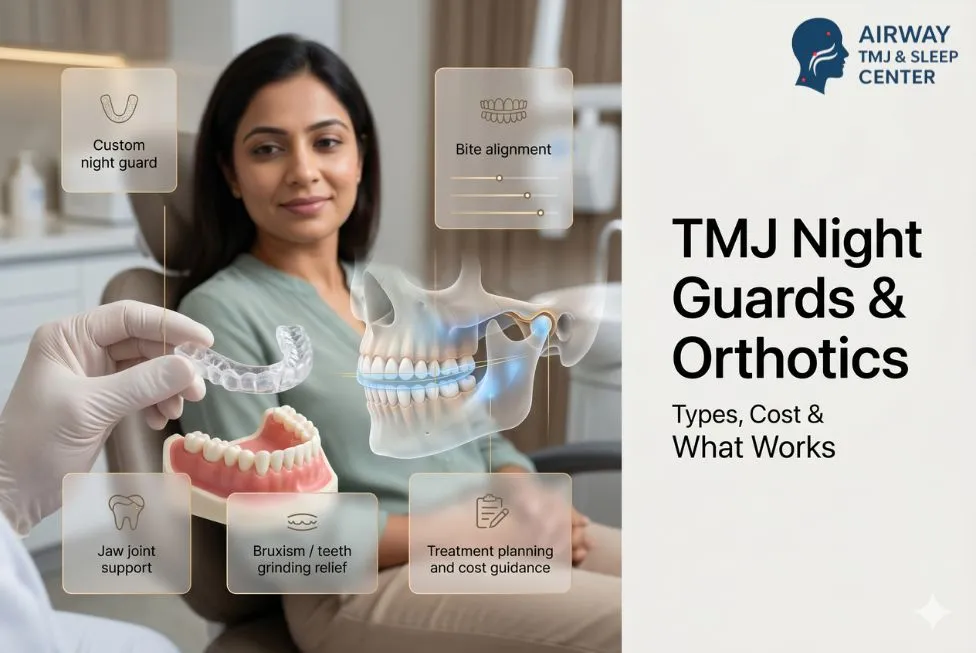
TMJ Night Guards and Orthotics: Types, Cost, and What Actually Works
If you have jaw pain, clicking, or grind your teeth at night, chances are someone has suggested a ‘night guard’ or a ‘orthotic’. But the two aren’t the same thing – and choosing the wrong one (or a cheap online version) can actually make TMJ worse. So before you buy anything, it’s worth understanding what these devices really do, the different types, what they cost, and how to know which one is right for you.
This guide breaks it all down: the difference between a basic night guard and a true TMJ orthotic, soft versus hard, custom versus over-the-counter, how long they take to work, and what to expect to pay in India.
Quick answer: A basic night guard just protects your teeth from grinding. A TMJ orthotic is a custom-made device that also repositions and stabilises the jaw to relax the muscles and ease the joint – so it treats the cause, not just the symptom. Custom orthotics are far more effective than over-the-counter guards (which can even worsen TMJ). Most people wear them at night, notice relief within 2-6 weeks, and see the best results by 3-6 months.
| Key takeaways
✓ A night guard protects teeth; a TMJ orthotic also stabilises the jaw and treats the cause. ✓ A poorly fitting over-the-counter guard can make TMJ worse – you clench harder against it. ✓ Soft orthotics give comfort and short-term relief; hard orthotics are more effective for real TMJ and grinding. ✓ They work: orthotics can cut clenching muscle force dramatically and ease pain and headaches. ✓ Most relief appears within 2-6 weeks, with best results by 3-6 months of consistent night-time use. |
Night Guard vs TMJ Orthotic: What’s the Difference?
People use these words interchangeably, but they do different jobs. A standard night guard is a barrier that stops your upper and lower teeth grinding against each other – it protects the enamel, but it doesn’t change your jaw position or address why you’re clenching. A TMJ orthotic goes further: it’s custom-made to hold your jaw in a more comfortable, stable position, relaxing the overworked muscles and taking pressure off the joint. In other words, a night guard manages a symptom; a TMJ orthotic helps treat the underlying problem.
| Basic night guard | TMJ orthotic | |
| Main job | Protects teeth from grinding | Stabilises and repositions the jaw |
| Treats the cause? | No – symptom only | Yes – relaxes muscles, eases the joint |
| Fit | Often over-the-counter | Always custom-made by a dentist |
| Best for | Mild grinding, tooth protection | TMJ pain, clicking, clenching, headaches |
Why a Cheap Over-the-Counter Guard Can Backfire
This is the most important warning in this guide. A generic, boil-and-bite night guard from a pharmacy or online may seem like an easy fix, but if it doesn’t account for your jaw’s natural resting position, you can end up clenching harder against it all night – increasing the strain on your TMJ rather than relieving it. For genuine TMJ problems, a properly fitted, custom device is not a luxury; it’s the difference between relief and a worse problem.
Types of TMJ Orthotics
Not all orthotics are the same. The right type depends on your symptoms and how severe they are.
| Type | What it is | Best suited to |
| Soft orthotic | Flexible, cushioning material; comfortable to wear | Mild grinding and short-term, symptomatic relief |
| Hard (acrylic) orthotic | Rigid, stable biting surface | Genuine TMJ disorders and heavier grinding |
| Stabilisation orthotic | A hard orthotic that gives an even, joint-friendly bite | Relaxing muscles and easing TMJ pain |
| Repositioning orthotic | Guides the lower jaw into a healthier position | Disc displacement and specific bite issues |
Soft vs hard, simply put: soft orthotics are comfortable and ease symptoms but don’t really treat the disorder; hard orthotics are more stable and effective for real TMJ and severe grinding. Which one suits you is a decision best made with a specialist after examining your bite and joint.
Do TMJ Orthotics Actually Work?
Yes – when they’re the right type and properly fitted. A well-made orthotic can dramatically reduce the force of your clenching muscles (by as much as 80% in heavy clenchers), which takes pressure off the joint and lets the muscles relax. The result is less jaw pain, fewer headaches, and reduced clicking for many people. It’s one of the most effective non-surgical treatments for TMJ – which is why it’s so often the first step.
| How long until it works – and how long to wear it
✓ Most people notice less muscle tension, jaw pain, or fewer headaches within 2-6 weeks ✓ Clearer improvement in jaw movement and pain usually appears by 8-12 weeks ✓ Best results typically come with 3-6 months of consistent, prescribed use ✓ Orthotics are usually worn at night, especially if you grind in your sleep ✓ Wear time and duration depend on your case – follow your specialist’s plan and reviews |
How Much Does a TMJ Orthotic Cost in India?
Cost depends on the type of device and your specific case. Basic oral orthotics in India are often available in the range of roughly Rs 500 to Rs 3,500, while custom, specialist-fitted TMJ orthotics designed to reposition the jaw cost more. Treat these as indicative figures – the precise cost comes after an examination, because the right device for a true TMJ disorder is tailored to your bite and joint. Remember that a correctly fitted custom orthotic, while more than an online guard, is what actually delivers relief – and protects you from making the problem worse.
Living With Your Orthotic: Eating and Care
- Most night guards and orthotics are removed for meals; some daytime stabilisation orthotics can be worn while eating soft foods – follow your specialist’s advice.
- Rinse and gently brush it daily; avoid hot water, which can warp it.
- Keep it in its case when not in use, and away from pets, who love to chew them.
- Attend follow-ups – a TMJ orthotic often needs small adjustments to work at its best.
- It shouldn’t hurt. Mild adjustment is normal at first; ongoing pain means it needs reviewing.
Why Choose Airway TMJ & Sleep Center in Noida
A orthotic is only as good as the diagnosis and fit behind it – and a generic one can do more harm than good. At Airway TMJ & Sleep Center in Noida, Dr. Kishlay Gaur uses detailed neuromuscular diagnostics to find your jaw’s ideal position, then designs a custom orthotic that genuinely relaxes the muscles and unloads the joint – not just a barrier for your teeth. With proper fitting and follow-up, this is one of the most reliable, non-surgical routes to lasting TMJ relief.
The Bottom Line
If TMJ pain, clicking, or night-time grinding is affecting you, a well-made orthotic can be genuinely life-changing – but the details matter. A basic night guard protects your teeth; a custom TMJ orthotic treats the cause. Avoid cheap, ill-fitting online guards that can worsen the strain, choose the right type for your case, and give it the 3-6 months of consistent use it needs to do its best work. Done properly, it’s one of the simplest, most effective ways to get your jaw – and your sleep – back on track.
Book a TMJ orthotic consultation in Noida to get a custom-fitted device designed around your bite – and real, lasting relief.