
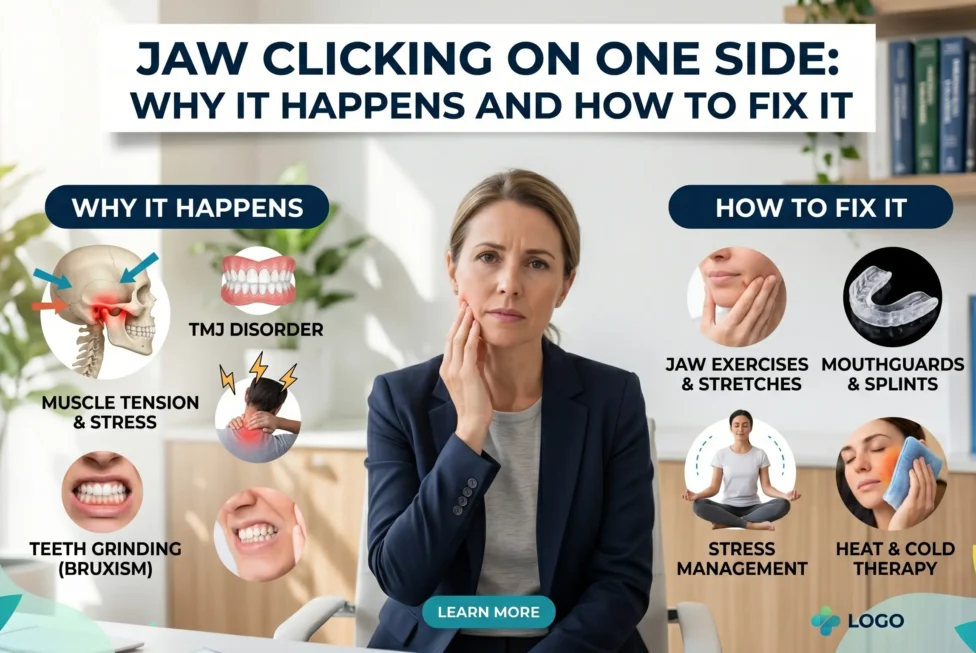
Jaw Clicking on One Side: Why It Happens and How to Fix It
Jaw clicking on one side usually happens when the small cushioning disc inside your jaw joint (the TMJ) slips slightly out of position, so the joint catches and then releases as you open or close your mouth. Occasional clicking with no pain is common and often harmless. But clicking that is frequent, getting louder, or comes with pain, locking, or limited opening is an early sign of a TMJ disorder that should be checked – because it is far easier to treat early than late.
Key takeaways ✓ A clicking or popping jaw on one side is most often caused by TMJ disc displacement or muscle imbalance. ✓ Painless, occasional clicking is usually not urgent – but worsening, painful, or locking jaws need evaluation. ✓ Common triggers: night-time clenching and grinding, stress, an uneven bite, poor posture, and past jaw injury. ✓ Most cases improve with conservative, non-surgical care: a custom oral appliance, jaw exercises, and habit change. ✓ Catching it early prevents the disc from slipping further and turning into chronic pain or jaw locking. |
What Does Jaw Clicking on One Side Actually Mean?
Your temporomandibular joint, or TMJ, is the hinge that connects your lower jaw to your skull, just in front of each ear. Between the ball and socket of this joint sits a small disc of cartilage that lets the jaw glide open and shut smoothly. When everything is aligned, the movement is silent. When the disc shifts forward or to the side, the jaw has to jump over it to move – and that jump is the click or pop you hear and feel.
Because the left and right joints rarely wear in exactly the same way, it is very common to notice the sound on one side only. One joint may be carrying more load, sitting under more muscle tension, or have a disc that has drifted a little out of place while the other side stays quiet. That is why jaw clicking on one side is one of the most searched jaw symptoms – and why it deserves a clear, calm explanation rather than panic.
What Causes the Clicking or Popping Sound?
There is rarely a single cause. In most patients it is a combination of factors that gradually pull the joint out of its smooth working position. The table below summarises the most common ones.
| Cause | What happens in the joint | Typical clues |
| Disc displacement | The cushioning disc slips forward; the jaw clicks as it snaps over it | Click on opening and/or closing, often one side |
| Clenching & grinding (bruxism) | Constant pressure fatigues muscles and compresses the joint | Morning jaw tightness, worn teeth, partner hears grinding |
| Stress & muscle tension | Tight jaw and neck muscles change how the joint tracks | Symptoms flare in busy or anxious periods |
| Uneven bite (malocclusion) | Teeth do not meet evenly, loading one joint more | Bite feels off; clicking worse on the heavier side |
| Poor posture | Forward head and neck strain pull on jaw muscles | Long screen hours, neck and shoulder stiffness |
| Past injury or trauma | A knock or whiplash shifts the disc or joint | Clicking that started after an accident or dental work |
Jaw Clicking on One Side With Pain vs Without Pain
This is the single most useful distinction, and it is what most people really want to know. The presence or absence of pain changes how urgent the situation is.
Clicking without pain
A jaw that clicks on one side without pain, and opens normally, is usually low-risk. Many people live with a painless click for years. It does not automatically need treatment – but it is worth monitoring, because a painless click can be the earliest stage of disc displacement. If the sound stays the same and nothing else changes, gentle self-care and avoiding aggravating habits are often enough.
Clicking with pain
When the click is joined by pain – in the joint, the cheek, the ear, or the temple – it signals that the joint is irritated or inflamed. This is the point at which the condition is most treatable and most worth acting on. Pain means the muscles and disc are under real strain, and continuing to ignore it raises the risk of locking and longer-term dysfunction.
See a TMJ specialist promptly if you notice any of these ✓ Jaw pain that is constant or worsening, on one or both sides ✓ Your jaw locks, catches, or you cannot open or close fully ✓ Clicking that gets louder, or changes to a grinding/gravelly sound (crepitus) ✓ Pain in the ear, temple, or face, or new headaches linked to chewing ✓ Difficulty eating, talking, or yawning without discomfort |
Should You Be Worried About a Clicking Jaw?
For most people, the honest answer is: not immediately, but do not ignore it. A clicking jaw is the body flagging that the joint is not moving the way it should. Left unchecked, a small, painless click can progress in stages – first louder clicking, then occasional catching, then episodes where the jaw locks open or shut, and finally chronic pain that affects sleep, eating, and mood. The encouraging news is that this progression is not inevitable. Identified early, the great majority of cases are managed with simple, reversible, non-surgical treatment.
A note on grinding sounds: a sharp click is usually a disc issue, while a rough, sandy grinding noise (crepitus) can suggest more advanced joint wear and should always be checked. If your jaw also gets stuck or locks, that is a separate warning sign worth reading about.
How Is the Cause Diagnosed?
You cannot reliably tell the exact cause of one-sided clicking just by listening to it, which is why a proper assessment matters. A TMJ-focused evaluation typically includes:
- A detailed history – when the clicking started, whether there is pain, and habits like clenching, chewing gum, or nail-biting.
- A hands-on exam of how the jaw opens, deviates, and which muscles are tender.
- Bite and alignment analysis to see how the upper and lower teeth meet.
- Where needed, imaging or neuromuscular diagnostics to see how the disc and muscles behave during movement.
This is where a focused TMJ practice differs from a routine dental check-up: the goal is to find the underlying reason – muscle, disc, bite, or a mix – rather than just note that a click exists.
How to Stop Jaw Clicking: Treatment Options
Treatment almost always starts with the simplest, most reversible options and only escalates if needed. In practice, the steps below resolve or greatly improve most one-sided clicking.
1. Self-care and habit change (start here)
- Rest the joint: choose softer foods for a while and avoid wide yawning, gum, ice, and very chewy items.
- Become aware of daytime clenching – keep teeth slightly apart, lips together, jaw relaxed.
- Apply warmth to relax tight muscles, or a cold pack if there is swelling or sharp pain.
- Improve posture, especially during long screen sessions, to reduce neck and jaw strain.
2. Custom oral appliance therapy
A custom-made oral appliance is one of the most effective tools for a clicking, clenching jaw. Unlike a generic over-the-counter night guard, it is designed to your specific jaw position to take pressure off the joint, reduce night-time clenching, and let the disc and muscles settle. Many patients notice the clicking quieten within weeks.
3. Jaw exercises and physical therapy
Targeted exercises retrain the jaw to open evenly, strengthen weak muscles, and release overworked ones. Combined with manual therapy or massage, this helps the joint track correctly instead of jumping over the disc.
4. Neuromuscular and bite correction
If an uneven bite is driving the problem, correcting how the teeth meet – through neuromuscular orthodontics or bite balancing – addresses the root cause so the click does not simply return.
5. Surgery – rarely needed
Scientific evidence consistently supports trying conservative, reversible treatment first. Surgery is reserved for the small number of cases that do not respond to non-surgical care, and is rarely necessary.
Can You Prevent Jaw Clicking From Getting Worse?
Yes, in most cases. The same habits that trigger clicking also make it worse, so changing them protects the joint:
- Manage stress, since tension goes straight to the jaw and neck muscles.
- Treat night-time grinding early with a properly fitted appliance.
- Avoid overloading the joint with hard or chewy foods and gum.
- Keep good head and neck posture through the working day.
- Get a one-sided click checked before it becomes painful or starts locking.
Why Choose Airway TMJ & Sleep Center in Noida
TMJ problems sit at the crossroads of the joint, the muscles, the bite, posture, and even the airway – so they need someone who understands all of those layers. At Airway TMJ & Sleep Center in Noida, Dr. Kishlay Gaur focuses specifically on TMJ and orofacial pain, using detailed neuromuscular diagnostics to find the real reason behind one-sided clicking rather than just treating the symptom. The approach is non-surgical, personalised, and built around long-term comfort, so the problem is corrected at its source and is less likely to return.
The Bottom Line
A jaw that clicks on one side is common, and on its own – without pain or locking – it is usually not an emergency. But it is a clear signal that the joint is under strain, and it tends to respond beautifully to early, simple care. If your clicking is frequent, getting louder, painful, or your jaw is starting to catch, that is the moment to act. A short evaluation can tell you exactly what is happening and, in most cases, how to quiet it for good.
Book a TMJ evaluation in Noida to find out what is driving your jaw clicking and the simplest way to fix it.